The Adult Loneliness Cure: How to Connect from the Heart, Find Your Safe People, and Never Feel Isolated Again

Sabke beech rehkar bhi akela mehsoos karna sabse bada dard hai. Yahan seekho ki kaise apne safe log dhoondein aur dil se connect karein.
Disclaimer: This article reflects personal philosophy, sociological research, and lived experiences on human connection. It is intended for self-improvement and emotional wellbeing.
Listen to this Masterclass on the go
Ek baat sach-sach batao: kya kabhi tumhare saath aisa hua hai ki tum ek bheed bhare kamre mein khade ho, chaaron taraf log hans rahe hain, baatein kar rahe hain, par andar se tumhein lagta hai ki tum wahan bilkul akele ho?
Adulthood ka sabse bada silent dard yahi hai: school aur college ke dost apne-apne safar mein chale gaye, aur ab office ya social media par sab formal aur shallow lagta hai. Koi yeh nahi poochta ki *'Yaar, sach bata, andar se kaisa feel kar raha hai?'*
Main tumhein ek family member ki tarah yeh yakeen dilane aaya hoon ki tum akele nahi ho. Is blog mein, main tumhein koi corporate networking tips nahi dunga. Hum baat karenge ki kaise dil se dil ka rishta banta hai, kaise apne 'safe humans' dhoonde jaate hain, aur kaise bina darr ke doosron ke aage khula dil rakha jaata hai.
The 4-Stage Operating System: The Adult Loneliness Cure: How to Connect from the Heart, Find Your Safe People, and Never Feel Isolated Again
Tap each stage below to explore the chronological step-by-step framework:
Look at consistent effort rather than late-night sweet texts.
Hey friend, let's talk about something almost every adult secretly struggles with but rarely admits out loud: **Making real friends after age 22 feels ridiculously hard.** In school and university, your social life was handed to you on a silver platter. You were trapped in the same classroom for 7 hours a day with hundreds of peers of your exact age, living in the exact same life stage, with zero mortgage or quarterly deadlines to stress over. Friendships formed through pure passive osmosis.
Then you graduate. You land a job, start managing bills, stare at screens for 9 hours, and suddenly realize your social circle consists of coworkers you only talk to about Jira tickets and college friends who take three weeks to reply to a WhatsApp text. You aren't antisocial, and you aren't weird. You are simply experiencing the natural friction of modern adult life. When I was rebuilding my life after years of medical setbacks (as I shared in The Human Story), I had to learn how to rebuild authentic brotherhood and connection completely from scratch.
Ask our interactive BB Digital Twin on the homepage about daily confidence routines, conversation icebreakers, or dealing with social fatigue.
Talk to Digital Bhaway1. The 50-Hour Law: Why Friendships Require Time, Not Just Good Vibes
Why 90% Struggle vs How the Top 10% Win
- ✕Chasing daily hype, impulsive shortcuts, and emotional overreaction.
- ✕Operating without clear boundaries or written mathematical rules.
- ✕Giving up after 2 weeks when instant dopamine gratification fades.
- ✓Automated daily discipline that compounds quietly in the background.
- ✓Unshakable emotional calm during temporary setbacks or market dips.
- ✓Staying in the game for decades to unlock exponential compounding wealth.
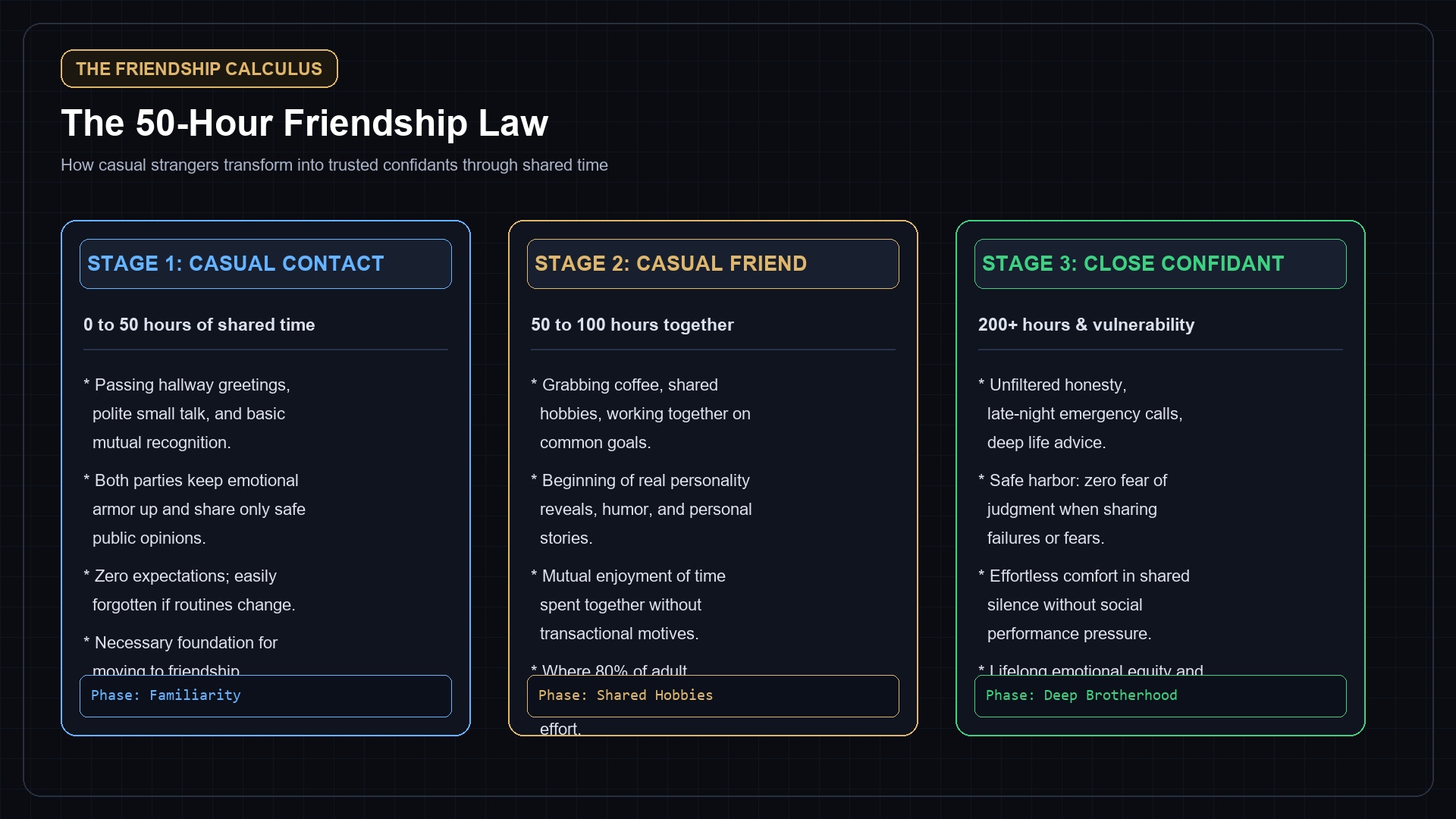
Dr. Jeffrey Hall, a renowned professor of communication studies at the University of Kansas, conducted a landmark study tracking how long it actually takes to make a friend. His mathematical findings should be pinned to every adult's desk:
- 50 Hours: The amount of shared, unstructured time needed to move someone from a complete stranger to a casual friend.
- 90 to 100 Hours: The time required to move from casual acquaintance to a true friend you happily hang out with outside of work.
- 200+ Hours: The threshold for becoming close confidants—the kind of friends you can call at 2:00 AM in an emergency without feeling like an inconvenience.
- The Key Insight: Most adults expect deep intimacy after meeting someone twice for a 45-minute drink. That is mathematically impossible. Friendships are built on compounded shared time, not instant lightning bolts.
Scenario: You meet a really cool person at a local workout class or design workshop. How do you move beyond polite nodding without seeming desperate?
Tap the option that matches your current intuition:
"Sabke beech rehkar bhi akela mehsoos karna sabse bada dard hai. Par tumhare log duniya mein hain—woh bhi tumhein dhoond rahe hain."
2. The 'Third Place' Framework: Why You Need a Venue Outside Work and Home
Smart Doubt Clearing AssistantLIVE AI
इस आर्टिकल को पढ़ते समय कोई भी सवाल या शंका हो, सीधे यहाँ पूछें:
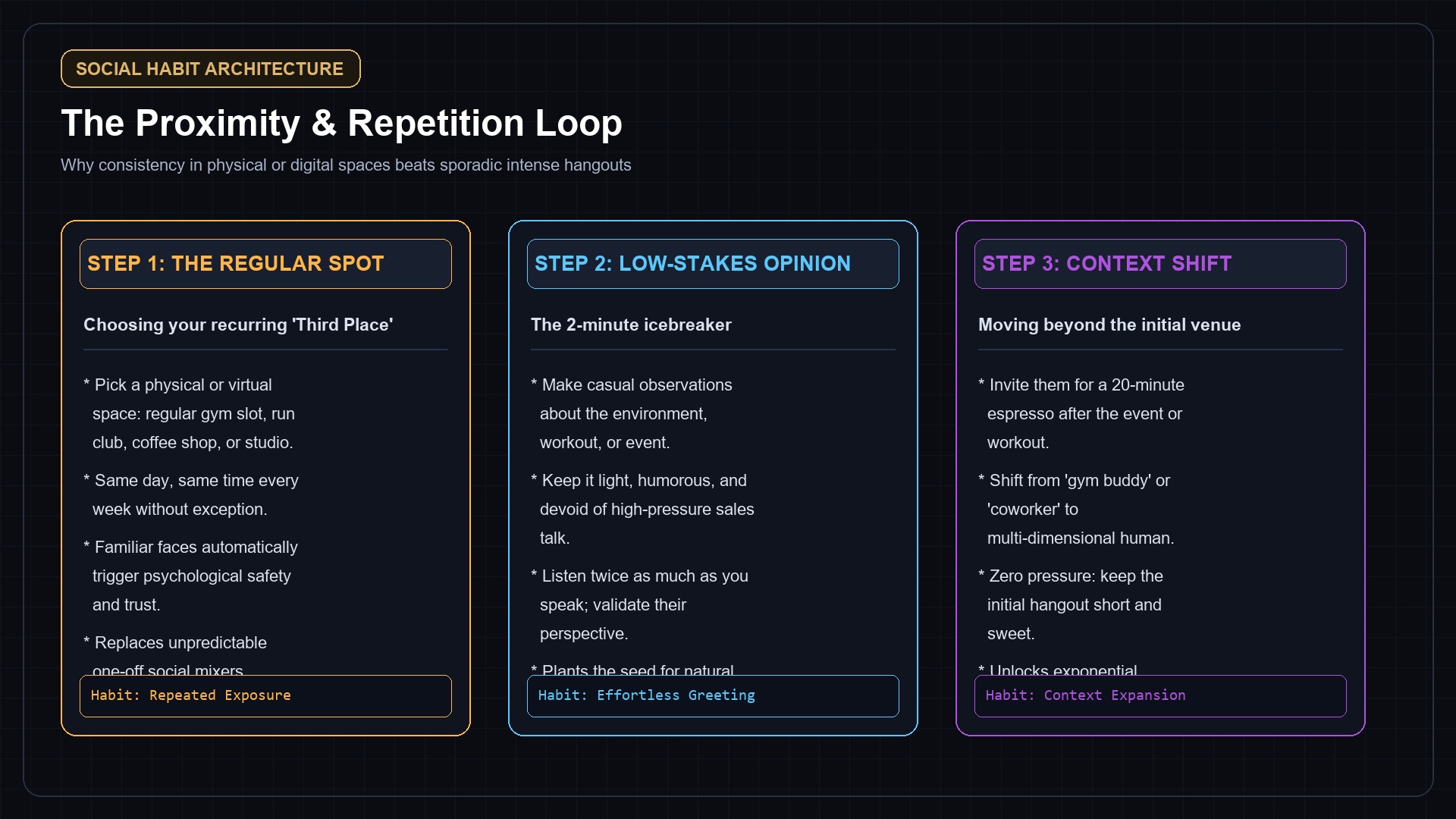
Sociologist Ray Oldenburg coined the concept of 'The Third Place.' Your first place is your home (family sanctum). Your second place is your work (performance, tasks, compensation). Your Third Place is a neutral public space where people gather regularly simply to exist and connect—a coffee shop, a bouldering gym, a book club, a community dog park, or a local run group.
When you only bounce between Home and Work, your opportunities for spontaneous human connection drop to near zero. If you want to make friends in your 20s and 30s, pick ONE recurring Third Place and show up at the exact same hour every single week. The 'mere exposure effect' will do 80% of the heavy lifting for you.
| Setting | Why It Works for Adults | Initial Friction | Long-Term Friendship Potential |
|---|---|---|---|
| Active Gyms / CrossFit / Run Clubs | Shared physical exertion creates instant camaraderie and lowers social guard. | Moderate (physical sweat) | Extremely High (Consistent weekly schedule) |
| Skill Workshops / Hackathons | Shared intellectual mission; natural problem-solving banter. | Low (focused on topic) | High (shared career and building goals) |
| Volunteer / Animal Shelters | Attracts kind, empathetic, grounded human beings with strong morals. | Very Low (welcoming vibe) | Very High (aligned values) |
| Bar / Nightclub Scene | Loud, alcohol-fueled, transactional, fleeting connections. | Low to start | Very Low (rarely lasts past 2:00 AM) |
The 4-Stage Adult Connection & Friendship Blueprint
Turn awkward networking into authentic, lifelong brotherhood. Have questions on finding genuine friends? Chat with Digital Bhaway.
Choose Repeat-Presence Environments
Adult friendship requires repeated, unscheduled interactions. Join a local running club, attend regular tech meetups, or volunteer weekly where you see the same friendly faces naturally.
Ask Curiosity Questions, Not Boring Resumes
Skip 'What do you do for a living?' Instead ask: 'What project are you excited about lately?' or 'What book changed how you see things this year?' Spark their genuine passions.
The 30-Minute Coffee or Walk Invite
Keep first invitations short, casual, and low-stakes. A simple 30-minute coffee gives you both an easy exit while creating space for real conversation without pressure.
The Monthly Value-Add Check-In
Send a thoughtful podcast, article, or congratulations on their work every 2 to 3 weeks. True friendship compounds through gentle, consistent presence over time.
"Sabke beech rehkar bhi akela mehsoos karna sabse bada dard hai. Yahan seekho ki kaise apne safe log dhoondein ..."
— Bhaway Bhalla • System Principle
"Asli apnapan tab shuru hota hai jab tum apna nakli 'perfect' mukhauta utaar kar dil khol kar sach bolne ki himmat karte ho."
3. The 3 Golden Rules of Conversational Chemistry
When you do strike up a conversation, avoid the boring interrogation traps that feel like an HR interview ('So where do you work? How long have you lived here?'). Use these three warm conversational rules instead:
- Rule 1 — Drop the Social Resume: Ask about their current passions, crazy weekend hobbies, or dream travel bucket lists instead of their corporate job title.
- Rule 2 — Share a Small Flaw or Quirky Truth: Vulnerability creates an emotional green light for the other person to drop their guard. Saying 'Honestly, I get a little awkward at these big events' immediately makes people love you.
- Rule 3 — Master the Second Question: Anyone can ask 'How was your weekend?' Master conversationalists listen to the answer and ask a thoughtful follow-up: 'You mentioned hiking near the lake—did you catch the sunset or get caught in the rain?'
"People don't remember the exact clever words you spoke; they remember how safe, seen, and energized they felt in your presence."
4. The 7-Day Adult Friendship Sprint: Actionable Steps to Take This Week
Reading about friendship theory is useless if you remain cooped up in your apartment every evening. Here is your actionable, step-by-step 7-day challenge to make your first genuine adult connection this week:
- Day 1: Identify your recurring Third Place. Pick a local run club, bouldering gym, pottery studio, or coffee shop with shared community tables.
- Day 2: Commit to a consistent weekly time slot (e.g. every Tuesday 7:00 AM or Saturday 10:00 AM) and put it on your calendar as a non-negotiable personal appointment.
- Day 3: Show up, make eye contact, and give 3 friendly smiles or nods to regulars. No pressure to start a 40-minute conversation yet; simply establish familiar presence.
- Day 4: Use the 2-minute observational icebreaker. Comment casually on the environment, workout, or music. Listen twice as much as you speak.
- Day 5: Invite an acquaintance for a 15-minute low-stakes coffee after the class. Remember: keep it specific, bounded by time, and effortless.
- Day 6: Send a warm 2-sentence follow-up: 'Great catching up yesterday! Hope your weekend launch goes smoothly.'
- Day 7: Reflect on how much easier connection feels when you take off the social performance mask. Ask our BB Digital Twin for personalized icebreakers anytime!
Check out our founder philosophy on The Human Behind My Story to see how building genuine community transformed my life after prolonged recovery.
Read The Story on Homepage5. The Vulnerability Paradox: Why Showing Imperfection Attracts Real Allies
Many high-achieving professionals think they need to project an aura of flawless success to make friends. But perfection repels intimacy; vulnerability invites connection. When you admit that you had a stressful week or struggled with a project, others exhale in relief because they realize you are a real human being. Pair this authenticity with our Overcoming Social Anxiety Playbook and explore partnership opportunities at Work With Me.
Where Should You Focus Your Energy First?
Click any quadrant to reveal high-leverage execution priorities:
Automate your basic routines today (auto-SIP, room rent sub-limit audit, muting toxic notifications).
Skill-stacking AI automation, restructuring portfolio, setting deep-work boundaries with family/partner.
Checking monthly statements, standard car checkup, weekly housekeeping habits.
Overthinking past decisions, arguing on social media comments, timing daily stock market fluctuations.

Bhaway is a systems builder, AI architect, and digital media founder. Having managed enterprise technical operations across Concentrix (Dell & Uber) and launched platforms like AI Is Everywhere and PromptLagao, he documents first-principles frameworks across human relationships, compounding wealth, and AI leverage.
Stay Connected Inside Bhaway's Digital Headquarters
Every system, brand, and framework discussed in this article is actively maintained and operated in public. Continue your exploration:
Ask BB • Article Explainer & Summary
Interactive AI breakdown for "The Adult Loneliness Cure: How to Connect fro..."
Sabke beech rehkar bhi akela mehsoos karna sabse bada dard hai. Yahan seekho ki kaise apne safe log dhoondein aur dil se connect karein.
- •The 50-Hour Law proves friendship requires deliberate time investment: 50 hours of shared time turns a stranger into a casual friend, and 200+ hours creates a close confidant.
- •The Proximity & Repetition framework works best by establishing a recurring 'Third Place' (gym, run club, creative studio, or regular cafe) visited at the same weekly schedule.
- •Vulnerability precedes intimacy: moving from safe small talk to sharing real challenges unlocks reciprocal trust and dissolves adult awkwardness.
What Should I Read Next?
You just finished exploring "The Adult Loneliness Cure: How to Connect from the Heart, Find Your Safe People, and Never Feel Isolated Again". To maximize your retention and avoid fragmented reading, follow this structured 3-step sequence:
Get 1 Practical Idea Daily.
No spam, no promotional fluff. A 2-minute actionable blueprint on modern relationships, quiet wealth compounding, or AI execution delivered directly to your inbox every morning.
FAQ
Frequently Asked Questions
Why is it so much harder to make friends in your 20s and 30s than in school?
In childhood and college, you had built-in proximity, repeated unplanned interactions, and a shared setting with peers in the same life stage. In adulthood, work and family routines require deliberate, scheduled planning to recreate those conditions.
How many hours does it take to make a close friend as an adult?
Research by Dr. Jeffrey Hall shows it takes approximately 50 hours of shared time to form a casual friendship, 90 hours to become a real friend, and over 200 hours of shared vulnerability to become close confidants.
What is the best way to invite an acquaintance to hang out without seeming awkward?
Keep the invite low-pressure, specific, and bounded by time. For example: 'I am grabbing an iced coffee down the street between meetings—care to join for 15 minutes?' This gives them an easy out and eliminates pressure.
Where can adults meet genuine, high-quality friends outside of work?
Active third places centered on shared habits—such as run clubs, bouldering gyms, community volunteering, skill hackathons, and creative maker spaces—are far superior to loud bars or superficial networking mixers.
How do I overcome the fear of rejection when reaching out to someone new?
Remember the 'Liking Gap' psychological study: people almost always like you significantly more than you think they do. Most adults are secretly eager for new connections but are just as hesitant to make the first move.
How can I turn a work colleague into an outside-of-work friend?
Shift the context gradually. Start with a lunch outside the office building, then invite them to a shared hobby or weekend event that is completely unrelated to company projects or office gossip.
What should I do if an acquaintance never initiates plans?
Test the reciprocity gently. Initiate two or three thoughtful invites. If they always accept with enthusiasm but never initiate, have an open conversation or dial back your energy to see if they step forward.
How many close friends does an adult actually need for emotional wellbeing?
Dunbar's number and modern psychological research suggest having 3 to 5 deeply trusted confidants provides optimal emotional support, lower stress, and higher life satisfaction than having 50 superficial acquaintances.
How do I make friends if I have introverted tendencies or social anxiety?
Focus on 1-on-1 interactions around structured activities (like chess, book discussions, or pottery) rather than large unstructured parties. Let the shared activity carry the conversation during quiet moments.
Where can I discuss personal social growth and daily habit building?
You can interact directly with our BB Digital Twin on the homepage for personalized questions on social confidence, daily discipline routines, and personal development.
Topic Tags
Recommended Interactive Tools For You
Put the concepts in this article into immediate practice. Zero paywalls, instant calculations, and confidential browser-local analysis.
Love vs Attachment Test
Uncover whether your bond is driven by true emotional connection or subconscious fear of being alone.
Modern Red Flag Scanner
Audit green, yellow, and red behavioral patterns in modern dating, texting habits, and emotional respect.
Situationship Detector
Diagnose whether you're in a genuine relationship or an emotionally draining situationship with honest next steps.
Relationship Health Score
Evaluate your relationship across 4 core pillars: emotional safety, trust, respect, and mutual daily effort.



Community Discussion
Comments (1)
Super insightful post! The clear breakdown made it effortless to understand and apply.
Thanks Aman! Really glad this clicked for you. Let me know what you think once you try it out!