Protecting Your Mental Peace: 7 Silent Red Flags of Energy Vampires & How to Set Loving Boundaries Without Guilt

Jo log tumhari khushi mein khush nahi ho sakte, unhe apni zindagi ke sabse kareeb rakhna band karo. Apni shanti bachana tumhara haq hai.
Disclaimer: This guide is intended for personal emotional clarity and healthy boundary setting. It does not replace professional mental health or relational therapy.
Listen to this Masterclass on the go
Kahin aisa toh nahi ho raha ki kisi se baat karne ke baad tumhara sir dard karne lagta hai? Tum unki har problem mein emergency ambulance ki tarah daud kar jaate ho, par jab tumhein kisi ke kandhe ki zaroorat hoti hai, toh woh gayab ho jaate hain?
Hum aksar un logon ko apne seene se laga kar rakhte hain jo chupke se hamare pankh kaat rahe hote hain. Kyun? Kyunki hamare andar darr hota hai: *'Agar maine inhein chhod diya, toh mera kaun bachega?'*
Suno meri baat dhyan se: **Akela rehna us rishte se sau guna behtar hai jo har roz tumhari aatm-samman (self-worth) ko dheere-dheere katar raha ho.** Aao, milkar seekhte hain ki bina kisi jhagde ke, bina guilt ke, apni boundaries kaise banate hain.
The 4-Stage Operating System: Protecting Your Mental Peace: 7 Silent Red Flags of Energy Vampires & How to Set Loving Boundaries Without Guilt
Tap each stage below to explore the chronological step-by-step framework:
Look at consistent effort rather than late-night sweet texts.
True friendship is supposed to be a sanctuary—a warm harbor where you can take off your heavy armor, speak unfiltered truths, and feel unconditionally supported. But what happens when spending time with a 'friend' consistently leaves you feeling drained, criticized, anxious, or emotionally bankrupt? The hardest truth in adult life is that **not everyone who smiles in your photos has your best interests at heart.**
When you are ambitious, kind-hearted, and generous (traits we celebrate at Bhaway Ecosystem), you naturally become an attractive target for emotional opportunists. Learning to audit your relational circle is not selfish; it is the fundamental prerequisite for mental clarity, productive deep work, and long-term peace.
Diagnostic Test: You just landed an incredible career milestone or personal goal and share it in your group chat. A friend replies: 'Wow, must be nice to get so lucky! Wish things were handed to me like that haha.' How do you interpret this?
Tap the option that matches your current intuition:
"Jo log tumhare sapno par chupke se haste hain, unhein apni zindagi ke VIP box mein mat baithao. Apni shanti sabse anmol hai."
Why 90% Struggle vs How the Top 10% Win
- ✕Chasing daily hype, impulsive shortcuts, and emotional overreaction.
- ✕Operating without clear boundaries or written mathematical rules.
- ✕Giving up after 2 weeks when instant dopamine gratification fades.
- ✓Automated daily discipline that compounds quietly in the background.
- ✓Unshakable emotional calm during temporary setbacks or market dips.
- ✓Staying in the game for decades to unlock exponential compounding wealth.
1. The 7 Silent Red Flags to Watch Out For
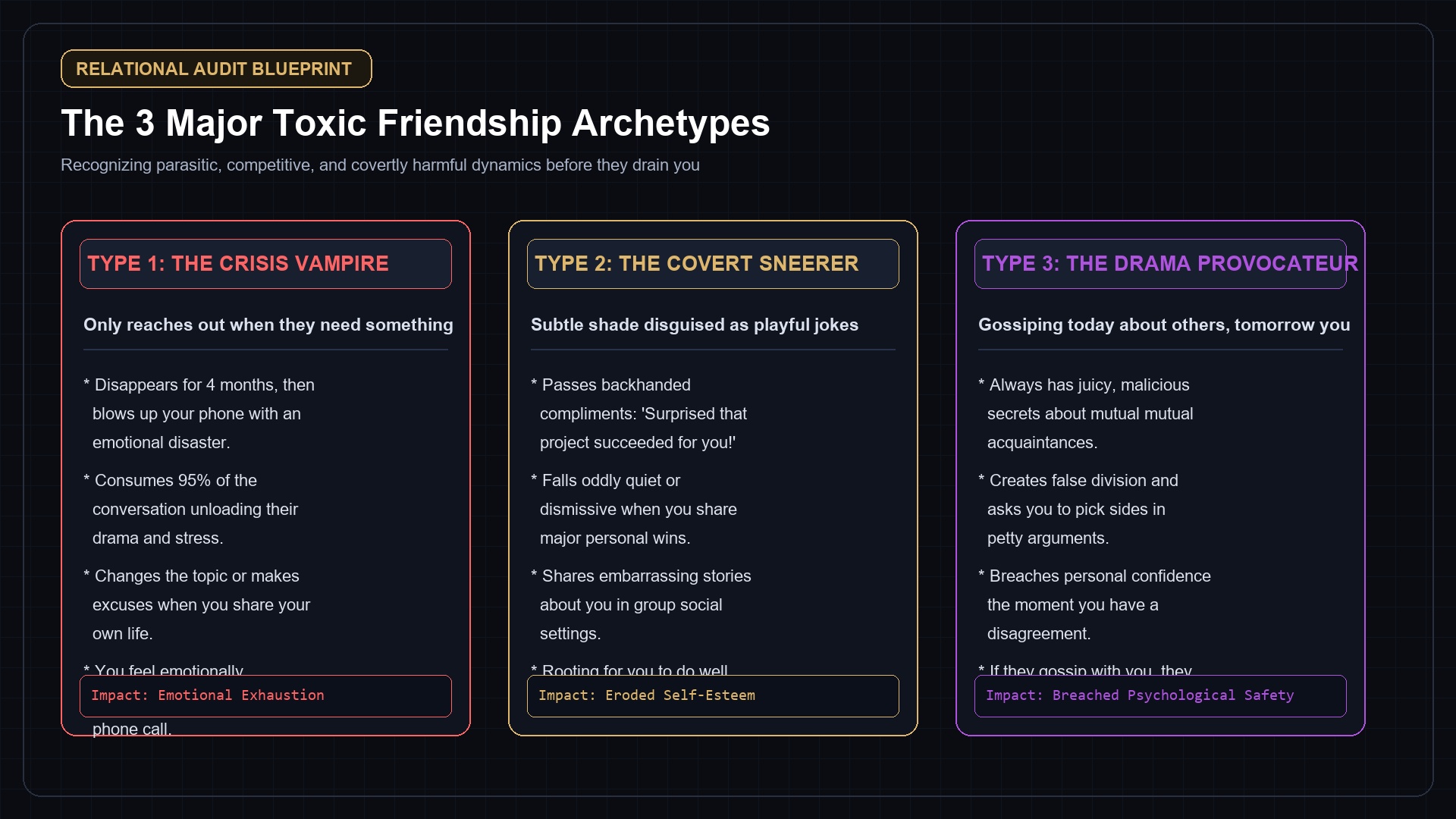
- Flag 1 — The Crisis Vampire: They vanish for months when things are calm, but blow up your phone with 40 panicked voice notes the second their life hits a crisis.
- Flag 2 — The Emotional Scorekeeper: They track every coffee they bought or ride they gave you in a mental spreadsheet, bringing it up to guilt you into compliance.
- Flag 3 — Strange Silence at Your Wins: When you fail, they are front row with comforting words (because it makes them feel superior). But when you succeed? Crickets.
- Flag 4 — The Casual Boundary Stepper: You clearly say 'I need an early night to prep for an exam/launch,' and they mock you or pressure you until you cave.
- Flag 5 — The Serial Gossip: If they gleefully tell you private, humiliating secrets about their other close friends, you can bet everything they do the same about you.
- Flag 6 — Subtle Micro-Aggressions in Public: They make subtle digs about your clothes, dating life, or finances in group dinners, hiding behind 'I was just teasing!'
- Flag 7 — Exhaustion After Every Interaction: Your gut and nervous system never lie. If you feel like you just ran a marathon after talking with them, the dynamic is toxic.
| Dynamic | Healthy Reciprocal Friendship | Toxic / Parasitic Friendship |
|---|---|---|
| Emotional Flow | Balanced two-way sharing; both feel deeply heard. | One-way dumping; you are treated like an unpaid therapist. |
| Reaction to Wins | Genuine celebration, pride, and shared excitement. | Passive-aggressive silence, backhanded compliments, envy. |
| Conflict Resolution | Calm talks, mutual apologies, focus on saving the bond. | Gaslighting, silent treatment, weaponized guilt trips. |
| Energy Post-Hangout | Grounded, rejuvenated, motivated, and happy. | Drained, second-guessing your words, emotionally exhausted. |
The 4-Step Emotional Wall & Boundary Reclamation Blueprint
Safely untangle yourself from one-sided, guilt-tripping friends without loud drama. Reflect on real leadership values at Bhaway's Story.
Objective Energy Audit
Log how you feel after interactions: are you energized or emotionally depleted? Notice if conversations are always about their emergencies while your wins are met with indifference.
Adopt Short, Calm, Polite Responses
Toxic guilt-trippers feed on defensive explanations. Stop writing long emotional justifications. Replace them with simple: 'I won't be able to make it, but hope it goes great!'
The Strategic Emotional Downshift
Slowly increase your response delay. Shift them from your inner circle of confidants to polite casual acquaintances without waging an aggressive war.
Invest Bandwidth in Reciprocal Allies
Pour your newly liberated emotional energy into family, uplifting peers, and meaningful creative work. See our collaborative community at Work With Me.
Smart Doubt Clearing AssistantLIVE AI
इस आर्टिकल को पढ़ते समय कोई भी सवाल या शंका हो, सीधे यहाँ पूछें:
"Apni shanti bachana koi selfishness nahi hai dost. Yeh apne dil aur dimaag ko zinda rakhne ki sabse badi zaroorat hai."
2. The Graceful Distance Protocol: Stepping Away Without World War III
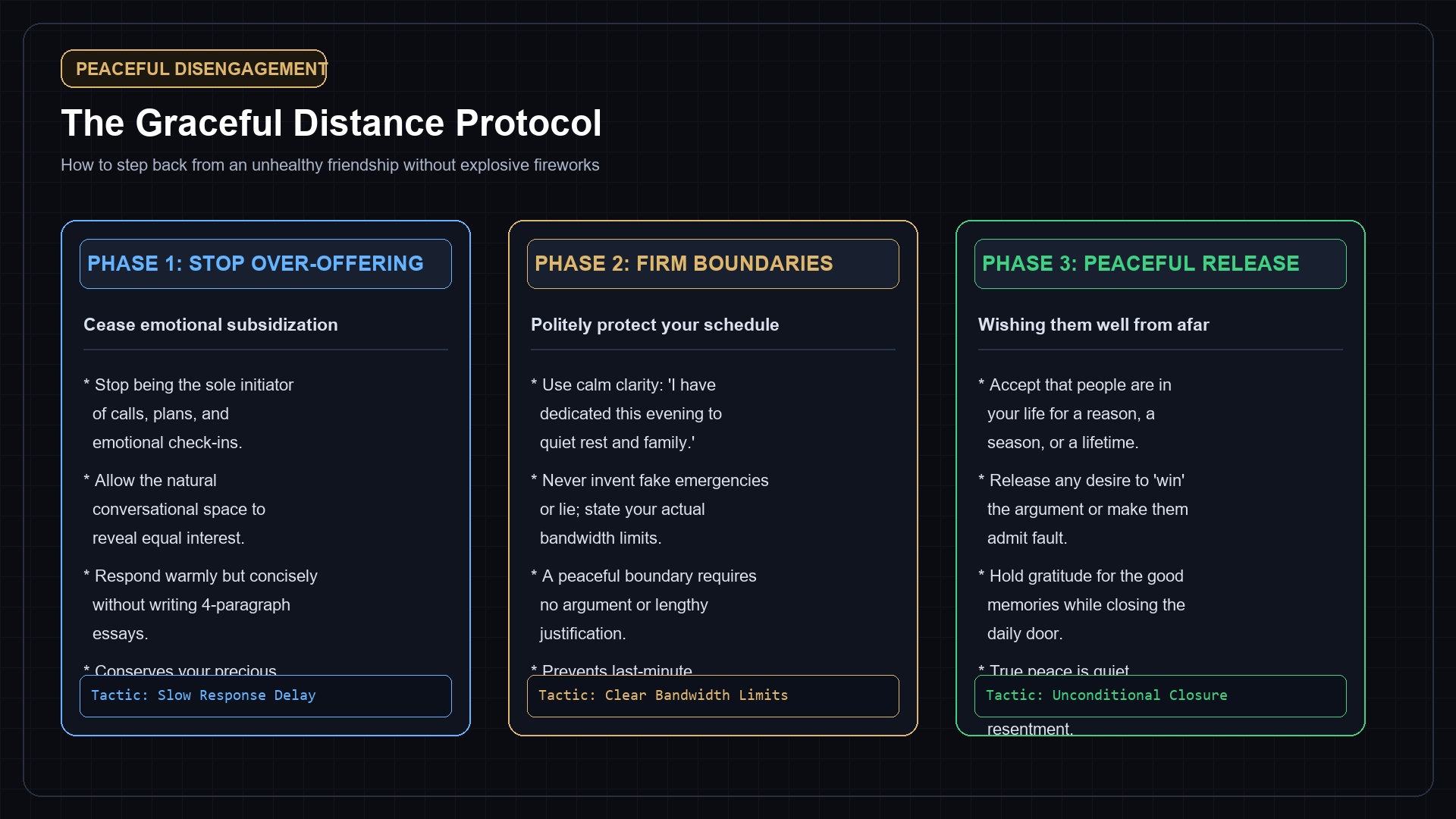
You do not need to stage an explosive, theatrical confrontation to end a toxic friendship. In fact, dramatic confrontations with manipulative people often give them the exact chaotic attention they crave. Use the **Graceful Distance Protocol** instead:
- Step 1: Stop Subsidizing the Dynamic: Stop being the sole engine initiating texts and organizing plans. You will be shocked at how quickly one-sided dynamics fade away on their own.
- Step 2: Lengthen Response Windows: You are not obligated to reply to emotional dumping within 30 seconds. Wait 3 to 4 hours, and reply warmly but concisely: 'Sounds like a challenging situation, I hope you find clarity! Heading into a deep focus block now.'
- Step 3: Hold Unwavering Schedule Boundaries: 'Thank you for thinking of me! Unfortunately my weekend schedule is completely committed to family and quiet rest.' Do not apologize or invent fake excuses.
- Step 4: Wish Them Well From Afar: You don't need to harbor hatred. Forgive them in your heart, acknowledge that their toxicity stems from their own unhealed trauma, and gently close the door.
"You can love people from a distance. You can wish them immense success and peace, while ensuring they no longer have front-row access to your life."
"Jo log tumhari khushi mein khush nahi ho sakte, unhe apni zindagi ke sabse kareeb rakhna band karo. Apni shant..."
— Bhaway Bhalla • System Principle
3. The 3-Step Friendship Cleanse: Reclaiming Your Mental Peace
When you finally decide to step back from an energy vampire or covertly jealous friend, you might experience an intense wave of guilt. You think: 'Am I a terrible, disloyal person for walking away?' Let me give you absolute clarity: **Protecting your mental clarity is not disloyalty; it is self-preservation.**
- Audit Your Emotional Ledger: If 90% of your interactions are emergency triage for their drama and 0% reciprocal support for your goals, the dynamic is an emotional debt.
- Mute, Do Not Block (Unless Abusive): Silent muting prevents digital notifications from hijacking your focus blocks during deep work (like the systems we use at AI Is Everywhere).
- Pour into Real Allies: Take the two hours a week you spent agonizing over their drama and invest it into your true champions and family. Check our guide on Turning Acquaintances into High-Trust Allies.
You can ask the interactive BB Digital Twin Console on our homepage to generate calm, respectful boundary messages tailored to any situation.
Ask BB Digital Twin for Boundary Scripts4. The Diplomatic Script: How to Say No Without Igniting an Explosion
Setting a boundary does not require an aggressive monologue. The best boundary scripts are brief, kind, and non-negotiable:
- Script for the Constant Complainer: 'I care about you deeply, but right now I don't have the mental bandwidth to discuss this topic. Let's talk about something that lifts us both up, or catch up next week.'
- Script for the Demanding Friend: 'I won't be able to make it this time, but I hope you have a wonderful time!'
- Script for the Backhanded Compliment: 'What an interesting comment—what did you mean by that?' (Watch them stammer and backpedal in real time).
For more on staying calm under emotional pressure, read Peaceful Living & Emotional Balance and discover how I navigated life-altering challenges in The Story Behind The Builder.
Where Should You Focus Your Energy First?
Click any quadrant to reveal high-leverage execution priorities:
Automate your basic routines today (auto-SIP, room rent sub-limit audit, muting toxic notifications).
Skill-stacking AI automation, restructuring portfolio, setting deep-work boundaries with family/partner.
Checking monthly statements, standard car checkup, weekly housekeeping habits.
Overthinking past decisions, arguing on social media comments, timing daily stock market fluctuations.

Bhaway is a systems builder, AI architect, and digital media founder. Having managed enterprise technical operations across Concentrix (Dell & Uber) and launched platforms like AI Is Everywhere and PromptLagao, he documents first-principles frameworks across human relationships, compounding wealth, and AI leverage.
Stay Connected Inside Bhaway's Digital Headquarters
Every system, brand, and framework discussed in this article is actively maintained and operated in public. Continue your exploration:
Ask BB • Article Explainer & Summary
Interactive AI breakdown for "Protecting Your Mental Peace: 7 Silent Red Fl..."
Jo log tumhari khushi mein khush nahi ho sakte, unhe apni zindagi ke sabse kareeb rakhna band karo. Apni shanti bachana tumhara haq hai.
- •Toxic friendships operate through asymmetrical emotional extraction: one person consumes all the care, advice, and celebration while offering zero reciprocal support in return.
- •Covert jealousy presents as backhanded compliments, strange silence during your major triumphs, and subtle attempts to minimize your accomplishments in group settings.
- •The Graceful Distance protocol allows you to step back peacefully: reduce conversational availability, cease unsolicited emotional subsidization, and avoid explosive drama.
What Should I Read Next?
You just finished exploring "Protecting Your Mental Peace: 7 Silent Red Flags of Energy Vampires & How to Set Loving Boundaries Without Guilt". To maximize your retention and avoid fragmented reading, follow this structured 3-step sequence:
Get 1 Practical Idea Daily.
No spam, no promotional fluff. A 2-minute actionable blueprint on modern relationships, quiet wealth compounding, or AI execution delivered directly to your inbox every morning.
FAQ
Frequently Asked Questions
How can I tell the difference between a friend having a bad week and a toxic friend?
A good friend going through a tough time acknowledges that they are leaning on you, expresses gratitude, and checks in on you when the storm clears. A toxic friend treats one-way emotional extraction as a permanent entitlement year-round.
Why do some friends act weird or cold when I achieve a big success?
Your breakthrough often acts as an uncomfortable mirror to their own stagnation or hidden insecurities. If they have defined their friendship with you by feeling slightly ahead, your growth disrupts their subconscious hierarchy.
Is it possible to fix a toxic friendship through communication?
If both people possess self-awareness and humility, an open, loving conversation can reset boundaries. However, if the person responds with defensive gaslighting or plays the victim, the pattern is usually structural.
How do I deal with a toxic friend who is part of my core mutual friend group?
Practice polite, cordial neutrality. Treat them like a respectful professional acquaintance at group gatherings—smile, say hello, but avoid sharing private vulnerabilities or engaging in 1-on-1 hangouts.
What should I say when a toxic friend asks why I have become distant?
Use calm, non-accusatory 'I' statements: 'My work, health, and personal priorities require my full energy right now, so I have had to dial back my social availability across the board.'
Why do I feel intense guilt when trying to cut off an unhealthy friendship?
Empathic, kind people are wired to prioritize harmony and feel responsible for other people's feelings. Remind yourself that protecting your mental peace is self-preservation, not cruelty.
Can a childhood friend become toxic as you grow older?
Yes. Shared history does not guarantee shared destiny or aligned values. Many people change dramatically between ages 15 and 30, and holding onto someone solely out of nostalgia can be detrimental.
How does keeping toxic friends around impact career and personal goals?
Negative relationships drain your cognitive decision-making bandwidth, instill self-doubt, and create ambient chronic stress that directly impairs your professional focus and creative output.
What is the 'Gray Rock' technique in managing difficult friendships?
It involves becoming as uninteresting and unreactive as a gray rock. By offering neutral, boring responses without emotional ammunition, drama-seeking individuals naturally lose interest and move on.
Where can I read more about building emotional resilience and boundaries?
Read our comprehensive guide on The Art of Peaceful Living and Healthy Boundaries for deeper frameworks on mental wellbeing.
Topic Tags
Recommended Interactive Tools For You
Put the concepts in this article into immediate practice. Zero paywalls, instant calculations, and confidential browser-local analysis.
Modern Red Flag Scanner
Audit green, yellow, and red behavioral patterns in modern dating, texting habits, and emotional respect.
Relationship Health Score
Evaluate your relationship across 4 core pillars: emotional safety, trust, respect, and mutual daily effort.
Situationship Detector
Diagnose whether you're in a genuine relationship or an emotionally draining situationship with honest next steps.
Loyalty & Trust Assessment
Measure relationship stability, emotional fidelity, honesty under stress, and boundary consistency.



Community Discussion
Comments (1)
Super insightful post! The clear breakdown made it effortless to understand and apply.
Thanks Aman! Really glad this clicked for you. Let me know what you think once you try it out!