The Deep Work Blueprint: How to Reclaim 4 Hours of Uninterrupted Daily Focus in a Distracted World
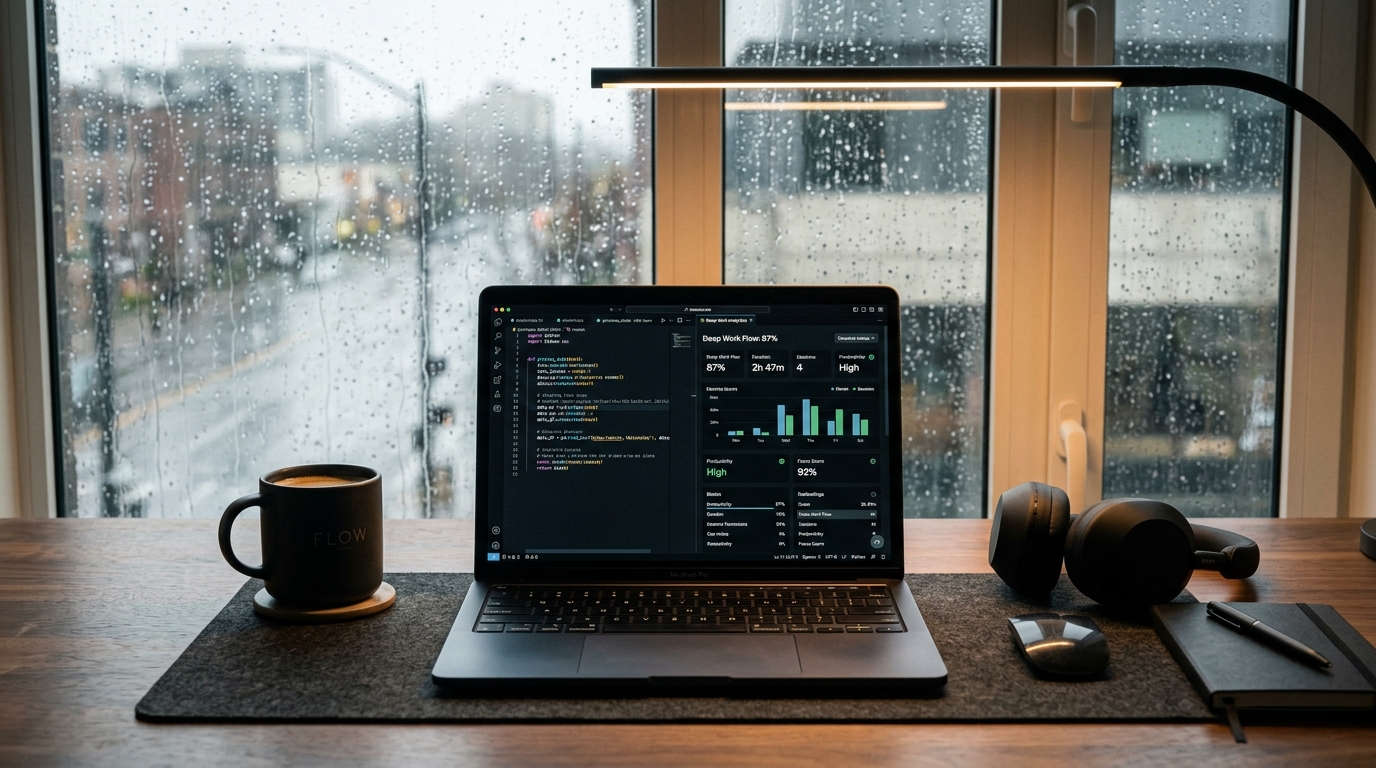
Knowledge work has become a flurry of frantic Slack messages, 30-minute Zoom syncs, and fragmented attention. Here is how to reclaim 4 hours of pure, deep, unbroken flow and 10x your creative output.
Disclaimer: This productivity blueprint reflects modern cognitive neuroscience and software engineering workflows. Adapt these time blocks according to your company culture and personal obligations.
Listen to this Masterclass on the go
Let's diagnose a typical Tuesday in the life of a modern professional, developer, or founder. You wake up at 8:00 AM, reach for your phone, and before your feet even touch the carpet, you have scanned 4 Slack channels, 12 WhatsApp groups, and an urgent email from a client. You sit at your desk at 9:30 AM with the noble intention of building that core feature or writing that strategic proposal. Then the pings begin.
A quick 15-minute 'standup' turns into a 45-minute debate. A colleague asks *'Got a quick sec?'* on chat. You check a bug ticket, open 18 documentation tabs, answer 3 emails, check LinkedIn for 4 minutes, and suddenly it is 6:30 PM. Your brain feels like fried eggs, your eyes burn, you are physically exhausted—and yet, if someone asked you what meaningful needle you moved today, you can't point to a single thing.
You didn't do real work today; you were merely an information router. In my years managing software systems, designing automated architectures at AI Is Everywhere, and shipping products as documented across My Professional Journey, I discovered that high-value breakthroughs require unbroken cognitive depth. If you cannot focus deeply for 3 uninterrupted hours, you will always be replaceable by basic AI automation.
The 4-Stage Operating System: The Deep Work Blueprint: How to Reclaim 4 Hours of Uninterrupted Daily Focus in a Distracted World
Tap each stage below to explore the chronological step-by-step framework:
Acknowledge where energy and focus are leaking.
Ask our BB Digital Twin for an automated time-audit formula to identify the top 3 communication drains in your current work calendar.
Run a Focus Audit with BB1. The True Cost of Context Switching: The 23-Minute Penalty
Dr. Gloria Mark, Professor of Informatics at the University of California, Irvine, conducted landmark studies tracking modern office workers. Her team discovered two alarming facts: first, the average knowledge worker is interrupted or switches tasks **every 3 minutes and 5 seconds**. Second, after being derailed by an interruption, it takes an astonishing **23 minutes and 15 seconds** to return to the original task with the same depth of focus.
Think about the terrifying math behind that! If you check your phone or Slack 8 times during a 4-hour morning, you never once entered flow state. You spent the entire morning in a state of cognitive whiplash that neuroscientists call 'attention residue'. A piece of your mind remains stuck on the last email you read, leaving only 40% of your brainpower available for the hard problem in front of you.
Why 90% Struggle vs How the Top 10% Win
- ✕Chasing daily hype, impulsive shortcuts, and emotional overreaction.
- ✕Operating without clear boundaries or written mathematical rules.
- ✕Giving up after 2 weeks when instant dopamine gratification fades.
- ✓Automated daily discipline that compounds quietly in the background.
- ✓Unshakable emotional calm during temporary setbacks or market dips.
- ✓Staying in the game for decades to unlock exponential compounding wealth.
Focus Health Audit: When was the last time you spent 120 minutes working on a single hard problem without touching a browser tab or checking your phone?
Tap the option that matches your current intuition:
2. Energy Management Over Time Management: Honoring Biological Rhythms
Cognitive Nutrition and Biological Hydration for Peak Focus
Most people view focus as an abstract mental attitude. The truth is that your brain is a physical organ consuming 20% of your body's metabolic glucose and oxygen despite accounting for only 2% of your body weight. If your biological vehicle is sluggish, dehydrated, or inflamed from processed seed oils and heavy carbohydrates, no productivity framework on earth can make you enter flow state.
Smart Doubt Clearing AssistantLIVE AI
इस आर्टिकल को पढ़ते समय कोई भी सवाल या शंका हो, सीधे यहाँ पूछें:
Start your morning deep work block by drinking 500ml of clean room-temperature water with a pinch of unrefined Himalayan pink salt or electrolytes. Mild dehydration (as little as 1.5% fluid loss) reduces prefrontal cognitive performance, impairs short-term memory, and spikes subjective fatigue by over 25%. Furthermore, avoid heavy breakfasts before deep analytical sprints: digestion diverts massive blood flow away from your cerebral cortex toward your gastrointestinal tract, triggering the classic mid-morning brain fog.
The Browser Air-Gap Architecture: Tab Bankruptcy
Open tabs are open cognitive loops. If your browser currently looks like a row of 48 tiny, unreadable favicons, your subconscious is continuously expending micro-units of attention scanning and worrying about unfinished tasks. Practice 'Tab Bankruptcy' at the start of every deep work session: bookmark all tabs into a folder named with today's date, close the entire browser window, and open a single fresh tab with only the active project workspace. The visual silence instantly calms your nervous system.
Time is linear; energy is cyclical. You have 24 hours in a day, but you only have roughly **4 hours of peak cognitive energy**. Trying to force yourself to write complex algorithms, draft legal contracts, or architect system databases at 3:30 PM when your body is experiencing its natural post-prandial circadian dip is an exercise in misery.
| Circadian Energy Phase | Ideal Work Type | Activities to Strictly Prohibit |
|---|---|---|
| Morning Peak (8:30 AM – 12:30 PM) | Deep Analytical Work: Coding, Strategy, Writing, Architecture | Email processing, status meetings, social media, Slack banter |
| Midday Trough (1:00 PM – 2:30 PM) | Biological Reset: Healthy lunch, walking outdoors, 20-min power rest | Starting complex new projects, critical negotiations, panic problem-solving |
| Afternoon Recovery (2:30 PM – 5:00 PM) | Collaborative & Administrative: Team syncs, code reviews, email triage | Expecting high creative breakthroughs under heavy fatigue |
| Evening Wind-Down (7:00 PM – 10:00 PM) | Cognitive Decompression: Reading books, music, family dinner, sleep hygiene | Looking at work dashboards or answering urgent midnight pings |
"Knowledge work has become a flurry of frantic Slack messages, 30-minute Zoom syncs, and fragmented attention. ..."
— Bhaway Bhalla • System Principle
When you respect this biological cadence, you stop fighting your biology. As we explored in our guide to AI Tools for Daily Life and Productivity, offloading low-leverage drafting and summarizing tasks to AI during your afternoon recovery phase frees up your morning peak for deep human judgment.
3. The 3 Defenses Against Attentional Vampires
You cannot protect deep work by hoping that other people will respect your time. Modern corporate culture is built on 'availability signaling'—proving that you are working by replying to messages within 90 seconds. To survive, you must erect three explicit operational defenses:
Defense 1: The Batched Communication Window
Close your email client and Slack completely during your deep morning block. Set your status to *'Deep Work Sprint: Next batch reply at 12:30 PM'*. Check communication strictly twice per day: once at 12:30 PM (to unblock colleagues before lunch) and once at 4:30 PM (to wrap up the day's coordination). 99% of things people label 'URGENT' can easily wait 3 hours without causing any harm.
Defense 2: The Physical Smartphone Air-Gap
A fascinating study from the University of Texas at Austin revealed that even when your smartphone is turned off and placed face down on your desk, your brain expends measurable cognitive resources actively resisting the urge to check it. You must physically move the phone into another room or inside a closed drawer. Out of sight is literally out of mind.
Defense 3: The Ruthless 'Not-To-Do' List
High performers are defined far more by what they decline than what they accept. Every time you say 'Yes' to an unnecessary sync or a frivolous favor, you are implicitly saying 'No' to your own creative masterpiece and your family's evening peace.
4. The 4-Hour Deep Work Protocol for High Performers
Here is the exact step-by-step protocol I use when engineering major technical platforms or writing deep strategic analyses:
The 4-Hour Flow Protocol
A battle-tested ritual to enter flow state on command and produce elite work
The Pre-Flight Ignition Ritual (5 Mins)
Clear your desk of all clutter. Fill a 1-liter water bottle. Put on noise-cancelling headphones playing 40Hz binaural beats or ambient lofi soundscapes without lyrics.
Sprint 1: The Analytical Heavy-Lift (90 Mins)
Work exclusively on your primary needle-mover. If a stray thought or unrelated chore pops into your head, write it on a physical notepad and immediately return to your task.
The Analog Intermission (15 Mins)
Step away from all screens. Do not look at your phone. Stretch, look out the window at the horizon, drink water, or do a short breathing exercise to flush cognitive fatigue.
Sprint 2: The Polishing & Synthesis Block (90 Mins)
Refine, test, debug, and complete the artifact you constructed in Sprint 1. Push code to repository, finalize the draft, or schedule client delivery.
The Clean Desktop Shutdown (10 Mins)
Commit your work, close your IDE tabs, and write tomorrow's morning anchor note so your subconscious can fully power down for the evening.
"In an age of infinite shallow distraction, the ability to concentrate deeply for four hours on a difficult problem is not just a skill—it is an economic monopoly."
How to Reclaim Your Focus Starting Tomorrow
- Block off 9:00 AM to 11:30 AM on your calendar tomorrow morning as an inviolable 'Deep Focus Sprint'. Decline any non-critical meetings during this window.
- Place your smartphone in another room before opening your laptop in the morning.
- Pick ONE complex problem you have been avoiding all week and make it your sole morning objective.
- Explore our related guide on The Simple Social Media & Digital Marketing Playbook to see how deep work fuels sustainable business growth.
- If you feel stuck or need personalized productivity guidance, reach out directly through My Contact Page.
Where Should You Focus Your Energy First?
Click any quadrant to reveal high-leverage execution priorities:
Automate your basic routines today (auto-SIP, room rent sub-limit audit, muting toxic notifications).
Skill-stacking AI automation, restructuring portfolio, setting deep-work boundaries with family/partner.
Checking monthly statements, standard car checkup, weekly housekeeping habits.
Overthinking past decisions, arguing on social media comments, timing daily stock market fluctuations.

Bhaway is a systems builder, AI architect, and digital media founder. Having managed enterprise technical operations across Concentrix (Dell & Uber) and launched platforms like AI Is Everywhere and PromptLagao, he documents first-principles frameworks across human relationships, compounding wealth, and AI leverage.
Stay Connected Inside Bhaway's Digital Headquarters
Every system, brand, and framework discussed in this article is actively maintained and operated in public. Continue your exploration:
Ask BB • Article Explainer & Summary
Interactive AI breakdown for "The Deep Work Blueprint: How to Reclaim 4 Hou..."
Knowledge work has become a flurry of frantic Slack messages, 30-minute Zoom syncs, and fragmented attention. Here is how to reclaim 4 hours of pure, deep, unbroken flow and 10x your creative output.
- •Context switching is the #1 killer of creative output: every interruption requires an average of 23 minutes and 15 seconds to regain deep cognitive flow, costing professionals hours of lost capability daily.
- •Manage energy, not just time: align demanding analytical problem solving with your biological circadian peaks (typically morning) and relegate administrative communication to post-lunch metabolic troughs.
- •The 4-Hour Deep Work limit is biological: even the world's elite concert violinists, grandmasters, and senior architects can only sustain 3 to 4 hours of peak cognitive focus per day; working 12 shallow hours is a vanity trap.
What Should I Read Next?
You just finished exploring "The Deep Work Blueprint: How to Reclaim 4 Hours of Uninterrupted Daily Focus in a Distracted World". To maximize your retention and avoid fragmented reading, follow this structured 3-step sequence:
Get 1 Practical Idea Daily.
No spam, no promotional fluff. A 2-minute actionable blueprint on modern relationships, quiet wealth compounding, or AI execution delivered directly to your inbox every morning.
FAQ
Frequently Asked Questions
How can I do deep work if my boss expects me to reply to Slack pings within 10 minutes?
Have a proactive, solution-oriented conversation with your manager. Frame it around business results: 'I want to deliver higher quality code/deliverables faster. I noticed that context switching cuts my output in half. Can we test a 2-week experiment where I am offline on Slack from 9:30 AM to 11:30 AM to finish our biggest project, with an emergency phone number available if the server is literally down?' 95% of great managers will enthusiastically agree.
Why can't I listen to music with lyrics while doing deep work?
Your brain's language processing center (Broca's and Wernicke's areas) is used when you write, code, or read. Listening to songs with lyrics creates linguistic interference, forcing your brain to decode the singer's words while simultaneously formulating your own thoughts. Choose instrumental, lofi, or binaural tracks instead.
Is it really true that 4 hours of deep work is the maximum human limit?
Yes. Landmark research by cognitive psychologist Dr. K. Anders Ericsson (the pioneer behind the 10,000-hour rule) studied world-class violinists, chess champions, and athletes. He found that deliberate, peak-intensity practice naturally caps out at 3.5 to 4 hours per day. Anyone claiming to do 10 hours of 'deep work' every day is simply doing shallow work.
What should I do if my mind keeps wandering to personal worries during my focus block?
Keep a physical 'Capture Pad' beside your keyboard. When a worry or task pops up (e.g., 'Pay electricity bill', 'Call mom back'), write it down in 3 words and tell yourself: 'It is safely recorded. I will handle it at 12:30 PM.' Externalizing it closes the open cognitive loop immediately.
How do I deal with the post-lunch energy crash?
Avoid heavy refined carbohydrate lunches (white rice, heavy pasta, sugary sodas), which spike your insulin and trigger severe drowsiness. Opt for clean protein, healthy fats, and greens. Take a 15-minute walk outside in natural sunlight right after eating to regulate your circadian clock.
Topic Tags
Recommended Interactive Tools For You
Put the concepts in this article into immediate practice. Zero paywalls, instant calculations, and confidential browser-local analysis.
Deep Work & Daily Focus Capacity
Audit your daily flow state capacity, context-switching leaks, and build 4 hours of uninterrupted execution.
Dopamine Addiction & Screentime Test
Diagnose compulsive short-form video consumption, digital fatigue, and reset your dopamine receptors.
3 AM Overthinking Cognitive Meter
Assess your racing thoughts, cognitive looping index, and implement a sleep and grounding protocol.
Nervous System Burnout Diagnostic
Check your nervous system overload stage, emotional exhaustion, and restorative boundary requirements.



Community Discussion
Comments (1)
Batching Slack replies to 12:30 PM and 4:30 PM felt scary at first, but my manager actually complimented my faster code delivery this week!
That's how high-leverage knowledge work is done Tanvi! Great managers care about shipped results, not who can reply to a gif in 30 seconds. Brilliant execution!