The Honest Beginner's Guide to Wealth & Share Market: How Real People Build Financial Freedom Step-by-Step

You don't need a finance degree, a Wall Street mentor, or millions in your bank to start investing. Here is the honest, friendly guide to the share market, compounding, and building true wealth in your 20s and 30s.
Disclaimer: This article is for educational and conversational purposes only and does not constitute financial or investment advice. Always do your own research or speak to a registered financial advisor before making investment decisions.
Listen to this Masterclass on the go
Hey friend, let's sit down and have a completely honest conversation about money. If you open Instagram, YouTube, or Telegram right now, you are probably bombarded by flashy 20-somethings standing in front of rented sports cars, showing green P&L screenshots, and promising you can 'make ₹50,000 a day trading options while sitting on a beach.' Let me tell you the harsh truth right away: 90% of retail day-traders lose their hard-earned money within their first 12 months. The share market is not a casino lottery ticket, and anyone treating it like one is heading for financial heartbreak.
Real wealth—the kind that lets you sleep peacefully at night, buy your freedom, and take care of your parents—is quiet, boring, and predictable. When I started working in technical operations and systems management (as you can see in My Professional Journey), I didn't come from a wealthy family. But I quickly understood that personal finance is an engineering system. Just like building automated workflows at AI Is Everywhere or creating digital ventures at PromptLagao, wealth follows simple mathematical rules. If you set up the right habits, financial freedom is just a matter of time.
You can ask our interactive BB Digital Twin on the homepage about personal budgeting rules, daily discipline routines, or time management tips.
Ask BB Digital Twin AnythingThe 4-Stage Operating System: The Honest Beginner's Guide to Wealth & Share Market: How Real People Build Financial Freedom Step-by-Step
Tap each stage below to explore the chronological step-by-step framework:
Liquid safety so you never panic-sell during market crashes.
1. The Silent Thief in Your Bank Account: Why Saving Alone Will Make You Broke
Our parents and school teachers taught us one piece of financial advice: 'Work hard, save whatever is left in your savings bank account, and you will be safe.' That was great advice in 1985 when inflation was lower and bank interest rates were in double digits. But in 2026? Saving all your cash in a regular bank account is a guaranteed way to lose wealth quietly.
Here is why: **Inflation is the silent tax.** If real inflation (groceries, healthcare, rent, schooling) is growing at 6% to 7% every year, and your bank savings account pays you 3%, you are losing 3% to 4% of your purchasing power every single year! In 10 years, ₹10 Lakhs sitting in a savings account will buy you significantly less than it buys today. Saving money is defense—it keeps you protected from sudden emergencies. But investing money is offense—it is the engine that multiplies your capital so you don't have to work until you are 70.
Quick Check: If the stock market crashes 20% tomorrow morning, what is your immediate natural gut reaction?
Tap the option that matches your current intuition:
Why 90% Struggle vs How the Top 10% Win
- ✕Chasing daily hype, impulsive shortcuts, and emotional overreaction.
- ✕Operating without clear boundaries or written mathematical rules.
- ✕Giving up after 2 weeks when instant dopamine gratification fades.
- ✓Automated daily discipline that compounds quietly in the background.
- ✓Unshakable emotional calm during temporary setbacks or market dips.
- ✓Staying in the game for decades to unlock exponential compounding wealth.
2. Demystifying the Share Market: What Are You Actually Buying?
Let's strip away all the confusing Wall Street jargon. When you buy a share of a company—whether it's Tata, Reliance, Apple, Microsoft, or HDFC—you are not buying a virtual betting slip. You are purchasing real fractional ownership in a living, breathing business that employs thousands of smart people, builds products people need, and earns millions in revenue every day.
Look around your room right now: you woke up to an alarm on your smartphone, brushed your teeth with toothpaste, turned on the lights, used electricity, drove a vehicle fueled by petroleum, and paid your bills through a digital banking app. All of those products and services were provided by publicly listed companies! Why spend your entire life being only a paying customer of these companies when you can easily own a slice of their profits?
| Investment Asset | Average Historical Return | Risk Profile | Best Used For |
|---|---|---|---|
| Bank Savings / FD | 3% – 7% | Very Low | Liquid Emergency Fund (3–6 months living expenses). |
| Gold / Sovereign Gold Bonds | 8% – 10% | Low to Moderate | Safe hedge against currency depreciation and macro crises. |
| Broad Index Funds (Nifty 50 / S&P 500) | 12% – 14% | Moderate (Long-Term Safe) | The core wealth-building engine for 95% of ordinary investors. |
| Direct Blue-Chip Stocks | 14% – 18% | Moderate to High | For investors who enjoy reading quarterly earnings reports. |
| Intraday F&O / Day Trading | Negative for 90%+ people | Extreme (Gambling) | Not recommended for building sustainable, long-term wealth. |
Smart Doubt Clearing AssistantLIVE AI
इस आर्टिकल को पढ़ते समय कोई भी सवाल या शंका हो, सीधे यहाँ पूछें:
3. The 8th Wonder: How Compounding Turns Small Monthly Habits into Life-Changing Fortunes
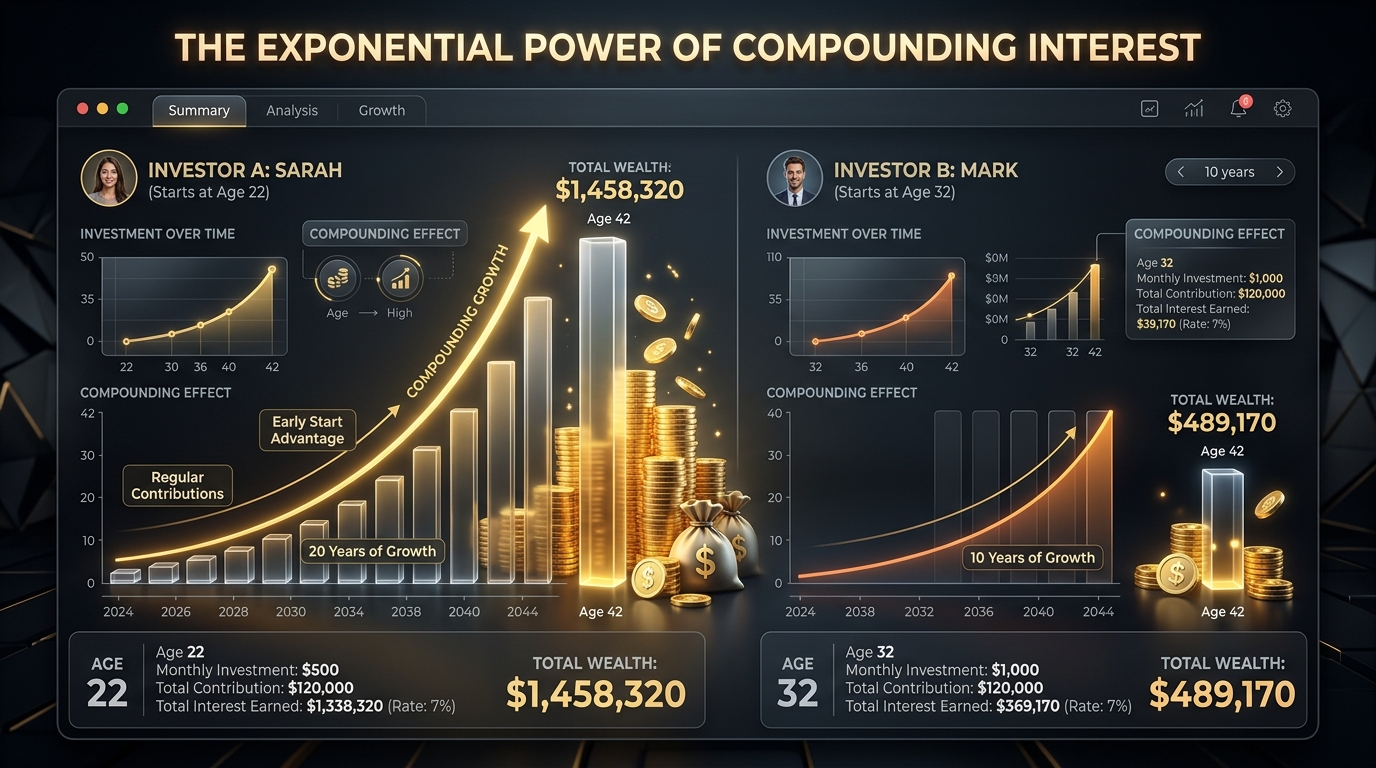
Albert Einstein famously described compound interest as the eighth wonder of the world: 'He who understands it, earns it; he who doesn't, pays it.' Compound interest simply means earning returns on your past returns. In the first 3 to 5 years, compounding feels painfully slow—you look at your account and think, 'I've been investing every month and I've only made a small profit!' But after year 10, the curve curves upward exponentially.
Let me give you a realistic example that will blow your mind:
- Rohan starts investing ₹5,000 (about $60) every month at age 22 in a simple, low-cost index fund that averages a 12% annual return. By age 45, Rohan has invested ₹13.8 Lakhs from his own pocket. But his portfolio balance? Over ₹72 Lakhs! Over ₹58 Lakhs of that is pure compound interest created out of thin air.
- Sneha waits until age 32 to start because she wanted to 'enjoy life first.' To reach the exact same ₹72 Lakhs by age 45, she has to invest almost ₹20,000 every single month—four times more cash every month just to catch up to the 10 years of lost compounding time!
- The Golden Lesson: Time in the market will always beat timing the market. Start with whatever you have today—even if it is ₹1,000 or ₹2,000 a month. The habit of starting early is 100x more powerful than waiting until you have a big lump sum.
"You don't need a finance degree, a Wall Street mentor, or millions in your bank to start investing. Here is th..."
— Bhaway Bhalla • System Principle
"The best investor in the room is not the genius with an IQ of 160. It is the person with average intelligence who has the emotional discipline to leave their compounding investments alone for 15 years."
The 4-Bucket Automated Compounding Blueprint
A peaceful, stress-free financial engineering framework. Want to test your monthly savings allocation? Ask our interactive AI Digital Twin.
Liquid Emergency Reserve (3–6 Months)
Park 3 to 6 months of essential living expenses in a liquid high-yield savings account or flexible FD. Never invest money in the share market that you will need within the next 24 months.
Automated Index SIPs (Salary Day Rule)
The morning your salary credits, an automated SIP into broad index funds (Nifty 50 or S&P 500) executes before lifestyle expenses. You invest first and spend whatever is left over.
High-Yield Digital Assets & Equity
Reinvest surplus profits into high-margin digital ventures and scalable automation tools. See how we build repeatable systems at AI Is Everywhere.
The 4% Safe Withdrawal Milestone
When your compounded portfolio reaches 25x to 30x your annual expenses, passive dividend yields cover your living costs forever. You work purely out of passion, not survival.
4. The 4-Bucket Financial Fortress: Sleep Peacefully at Night
Before you buy a single share or index fund, you must build your protective fortress. If you invest your rent money or grocery budget in the share market, and the market dips 8% next week, you will panic and sell at the absolute bottom. Here is the 4-Bucket Architecture I personally use to keep my finances unbreakable:
- Bucket 1 — Liquid Emergency Fund: 6 months of basic living expenses (rent, food, EMIs, utilities) parked safely in a high-interest savings account or liquid FD. This money is untouchable except for real medical or employment emergencies.
- Bucket 2 — Health & Pure Term Insurance: Protect your loved ones. One major hospitalization without insurance can wipe out 5 years of hard-earned savings in 48 hours.
- Bucket 3 — Automated Index Fund SIP: The core engine. An automated monthly transfer into low-cost broad index funds (like Nifty 50 or S&P 500) that happens on the 1st or 5th of every month right after salary day.
- Bucket 4 — High-Income Skill Reinvestment: The best investment that will ever exist is your own earning capacity! Reinvesting money into learning high-value skills like AI prompting, copywriting, operations, or marketing pays 1000% returns. Read our complete blueprint on How to 10x Your Career & High-Income Skills.
5. Five Costly Traps Beginners Must Avoid at All Costs
If you want to protect your financial future, steer clear of these five classic mistakes that wipe out beginner investors:
- Trap 1 — Telegram & WhatsApp 'Jackpot Stock' Groups: Ask yourself one simple question: if someone had a guaranteed formula to make 100% returns, why would they be selling you a ₹1,999 Telegram subscription? They make money from subscriptions, not from trading.
- Trap 2 — Watching the Stock Market App Every 15 Minutes: Compounding is like watching grass grow or paint dry. If you check your portfolio 20 times a day, your emotions will eventually force you to make an impulsive, stupid trade. Delete the app from your home screen.
- Trap 3 — Borrowing Money to Invest: Never, under any circumstances, take a personal loan, credit card advance, or margin leverage to invest in the stock market.
- Trap 4 — Trying to Time the Bottom: Trying to guess the exact day the market hits bottom is impossible. Even Warren Buffett doesn't do it. Just invest systematically every single month (SIP).
- Trap 5 — Forgetting to Upgrade Your Primary Income: You cannot invest ₹50,000 a month if you only earn ₹30,000. While your investments compound in the background, stay relentlessly focused on leveling up your primary earning skills.
Building wealth also means owning digital assets that generate revenue. Explore our ready-to-launch brand packages at PromptLagao or partner directly with Bhaway.
Explore 3 Active Brands on Homepage6. Bhaway's Question of the Day & Your Action Challenge
Here is my personal question for you today: **What is ONE unnecessary monthly expense or money leak you can redirect into an automated index fund starting this week?**
Let me share my own answer first: For me, it was ordering impulsive late-night food deliveries 3 to 4 times a week. When I calculated the total, I was blowing nearly ₹4,500 every single month on food that was making me sluggish. I redirected that exact amount into an automated monthly index fund SIP. Four years later, that small habit change has compounded into a substantial chunk of my portfolio.
Now it's your turn! What is your money leak? Is it unused streaming subscriptions, impulsive online shopping, or daily cafe bills? Scroll down to the comment box below and let me know your thoughts—I read and reply to every single comment personally!
Where Should You Focus Your Energy First?
Click any quadrant to reveal high-leverage execution priorities:
Automate your basic routines today (auto-SIP, room rent sub-limit audit, muting toxic notifications).
Skill-stacking AI automation, restructuring portfolio, setting deep-work boundaries with family/partner.
Checking monthly statements, standard car checkup, weekly housekeeping habits.
Overthinking past decisions, arguing on social media comments, timing daily stock market fluctuations.

Bhaway is a systems builder, AI architect, and digital media founder. Having managed enterprise technical operations across Concentrix (Dell & Uber) and launched platforms like AI Is Everywhere and PromptLagao, he documents first-principles frameworks across human relationships, compounding wealth, and AI leverage.
Stay Connected Inside Bhaway's Digital Headquarters
Every system, brand, and framework discussed in this article is actively maintained and operated in public. Continue your exploration:
Ask BB • Article Explainer & Summary
Interactive AI breakdown for "The Honest Beginner's Guide to Wealth & Share..."
You don't need a finance degree, a Wall Street mentor, or millions in your bank to start investing. Here is the honest, friendly guide to the share market, compounding, and building true wealth in your 20s and 30s.
- •Wealth creation is an automated engineering habit: automate monthly investments into low-cost broad index funds (Nifty 50 or S&P 500) rather than gambling on daily options trading.
- •The 4-Bucket Architecture protects your downside: Liquid Emergency Fund (6 months expenses), Security & Insurance, Equity Index Compounding, and High-Income Skill Reinvestment.
- •Compounding rewards emotional calmness: staying invested during inevitable market pullbacks beats trying to time market tops and bottoms.
What Should I Read Next?
You just finished exploring "The Honest Beginner's Guide to Wealth & Share Market: How Real People Build Financial Freedom Step-by-Step". To maximize your retention and avoid fragmented reading, follow this structured 3-step sequence:
Get 1 Practical Idea Daily.
No spam, no promotional fluff. A 2-minute actionable blueprint on modern relationships, quiet wealth compounding, or AI execution delivered directly to your inbox every morning.
FAQ
Frequently Asked Questions
1. How much minimum money do I need to start investing in the share market?
You can start with as little as ₹500 (or $10) per month! With modern discount brokers and Systematic Investment Plans (SIPs) in low-cost index funds, you don't need a huge lump sum. The most important step is simply starting early and allowing compounding to work its magic.
2. Is investing in the share market safe for absolute beginners?
Broad index funds (like the Nifty 50 or S&P 500)—which automatically invest in the top 50 to 500 largest profitable companies in the country—have historically created wealth over any 7 to 10 year period. Where beginners lose money is by gambling on daily options trading, intraday tips, or sketchy Telegram channels.
3. What is an Index Fund, and why do Warren Buffett and Bhaway recommend it?
An index fund is an investment fund that buys shares in all top companies of a market index in equal proportions. You get instant diversification across banking, IT, energy, and healthcare with tiny expense ratios (under 0.15%), consistently beating 85% of expensive active mutual fund managers.
4. What should I do first before putting money into the share market?
Always build your defensive fortress first! Save 3 to 6 months of living expenses in an untouchable liquid fixed deposit or high-yield savings account, and get adequate health and term insurance. If your living costs are covered, you will never panic and sell stocks during market dips.
5. What is the difference between an SIP and a Lumpsum investment?
A Systematic Investment Plan (SIP) automatically invests a fixed amount (e.g., ₹2,000) every month on a set date, averaging out market volatility through Rupee Cost Averaging. A lumpsum is investing a large sum at once. For most salaried professionals, automated monthly SIPs are far superior emotionally and financially.
6. How does compound interest actually create wealth over time?
Compound interest means your money earns returns, and then those returns earn their own returns. In the first 5 years, compounding feels slow. But after 10 to 15 years, the curve goes exponential—where your annual returns begin to exceed your entire yearly salary.
7. What is the 4-Bucket Financial Rule?
It is an engineering framework for personal finance: Bucket 1 is your Liquid Emergency Fund (6 months expenses), Bucket 2 is Safety (PPF/Term Insurance), Bucket 3 is Growth (broad index fund SIPs), and Bucket 4 is High-Income Skill Reinvestment (learning AI, marketing, and leadership).
8. What should I do if the share market crashes 20% or 30%?
Do NOT panic sell! Market pullbacks happen roughly every 12 to 18 months. They are not disasters; they are seasonal discount sales on great companies. Keep your automated SIPs running smoothly and avoid checking stock portfolio apps every 15 minutes.
9. Can I retire early or achieve financial freedom using index funds?
Yes! By automating 20% to 40% of your monthly income into index funds, maintaining a low-cost lifestyle, and continuously growing your primary income through High-Income Skills, you can achieve financial independence decades ahead of traditional retirement.
10. Where can I ask more personalized questions about personal finance and habits?
You can interact directly with our AI assistant, the BB Digital Twin on the homepage, or connect directly through our Contact Line.
Topic Tags
Recommended Interactive Tools For You
Put the concepts in this article into immediate practice. Zero paywalls, instant calculations, and confidential browser-local analysis.
Smart SIP & Compounding Calculator
Visualize how boring monthly investing creates life-changing compounding wealth, adjusted for 6% Indian inflation.
FIRE & Net Worth Calculator
Discover your exact Financial Independence number (30x annual expenses) and audit your asset-to-debt ratio.
Rich By 40 & Net Worth Growth
Calculate your wealth velocity, monthly savings rate impact, and projected net worth milestone at age 40.
Smart Loan EMI & Debt Freedom
Avoid dangerous debt traps with instant EMI calculations, total interest exposure, and prepayment savings.



Community Discussion
Comments (3)
The 4-bucket architecture makes so much sense! I was investing without an emergency fund and panicked during the last market dip. Setting up my liquid FD today.
Smart move Rohan! An emergency fund is your emotional armor. When living expenses are covered for 6 months, market dips feel like a seasonal discount rather than a crisis. Rooting for your journey!
Finally a finance article that speaks plain English instead of throwing boring charts at beginners. Shared this with my brother who just started his first job!
Thank you Pooja! Tell your brother to start with just ₹1,000 in a low-cost index fund this month. Starting early beats starting big every single time.
I used to lose money on Telegram F&O tips every single week. Stopping today and starting a quiet, automated Nifty 50 SIP.
That decision alone will save you lakhs of rupees and countless sleepless nights, Hardik. Boring investing builds exciting wealth. Welcome to the compounding club!