The Psychology of Money & Abundance: How to Break Scarcity Loops and Build Quiet Wealth

Why does having more money in your bank account rarely cure your anxiety about money? Here is the honest, psychological blueprint to breaking middle-class scarcity loops, healing financial stress, and building quiet, peaceful wealth.
Disclaimer: This article is for conversational, psychological, and educational purposes only and does not constitute formal financial advice. Always consult a licensed financial professional before making major investment decisions.
Listen to this Masterclass on the go
Let me share an uncomfortable memory from my early twenties that took me years to truly understand. I had just closed one of my first major consulting milestones. My bank account showed a number I had never seen before in my life. By all conventional logic, I should have felt an overwhelming sense of relief, safety, and triumph. Instead, do you know what I did? I stared at the banking app screen, felt a tight knot in the pit of my stomach, and whispered to myself: *'What if this is the last rupee I ever make? What if next month everything collapses?'*
That was the night I realized a profound truth that changed how I view life and business: **Money problems are rarely just math problems. They are psychological problems wearing a financial mask.** If your internal operating system is wired for scarcity, fear, and perpetual survival, you can win the lottery tomorrow and still wake up in a cold sweat feeling poor. As I often share when reflecting on My Professional Journey and building technical ventures like AI Is Everywhere, mastering your psychology is the prerequisite for keeping your wealth.
You can talk with our interactive BB Digital Twin right on the homepage for personalized reflections on money anxiety, career transitions, and mindful decision-making.
Talk to BB Digital TwinThe 4-Stage Operating System: The Psychology of Money & Abundance: How to Break Scarcity Loops and Build Quiet Wealth
Tap each stage below to explore the chronological step-by-step framework:
Acknowledge where energy and focus are leaking.
1. The Middle-Class Scarcity Trap: Why More Cash Doesn't Cure Financial Fear
Most of us grew up in households where money was the unspoken elephant in the living room. It was the whisper behind closed bedroom doors, the furrowed brow when the electricity bill arrived, the sigh when school fees were due. We were taught to believe that money was an extraordinarily fragile, elusive resource that required perpetual anxiety to maintain. We inherited what psychologists call 'financial vigilance trauma'—the belief that the moment you relax, disaster strikes.
When you grow up in that environment, you develop unconscious defense mechanisms. Some people become compulsive hoarders who feel physical guilt when buying a ₹200 cup of coffee or a book that could change their career. Others become financial avoiders who refuse to open their credit card statements because seeing the reality causes panic. Both behaviors stem from the exact same root: the belief that money controls you, rather than you controlling money.
Emotional Money Check: When you spend money on personal health, education, or quality food, what is your immediate reflex?
Tap the option that matches your current intuition:
Why 90% Struggle vs How the Top 10% Win
- ✕Chasing daily hype, impulsive shortcuts, and emotional overreaction.
- ✕Operating without clear boundaries or written mathematical rules.
- ✕Giving up after 2 weeks when instant dopamine gratification fades.
- ✓Automated daily discipline that compounds quietly in the background.
- ✓Unshakable emotional calm during temporary setbacks or market dips.
- ✓Staying in the game for decades to unlock exponential compounding wealth.

2. The 3 Destructive Money Scripts Running in Your Subconscious
Dr. Brad Klontz, a renowned financial psychologist, discovered through decades of clinical research that every human being operates under one of several core 'money scripts'. These scripts were formed before you turned twelve years old by watching how your parents handled money. Let's examine the three most common traps:
Script A: Money Avoidance ('Money is Dirty or Corrupting')
People with this script unconsciously believe that wealthy people are greedy, that wanting money is spiritually shallow, or that they don't deserve abundance. They will often sabotage lucrative contracts, undercharge for their services, or give away money until they are back to a familiar baseline of struggle. If you have ever felt ashamed to negotiate a higher salary or invoice a client for your real value, this script is whispering in your ear.
Smart Doubt Clearing AssistantLIVE AI
इस आर्टिकल को पढ़ते समय कोई भी सवाल या शंका हो, सीधे यहाँ पूछें:
Script B: Money Worship ('If I Just Had ₹1 Crore, All My Problems Would Disappear')
This is the classic hedonic illusion. You convince yourself that the void in your soul, the loneliness in your evenings, or the lack of purpose in your morning can be purchased away. You chase the next income jump, only to find that lifestyle inflation absorbs the raise and leaves you just as empty. Money solves money problems; it has never once solved an existential or spiritual problem.
Script C: Extreme Vigilance ('Disaster is Always Around the Corner')
This was my personal battle. Even with a year's worth of living expenses locked safely in an emergency fund, you feel like an imposter. You obsessively check bank notifications, check stock tickers during dinner, and refuse to enjoy the fruits of your honest labor. It turns life into a grim marathon where the finish line keeps moving backward.
"Why does having more money in your bank account rarely cure your anxiety about money? Here is the honest, psyc..."
— Bhaway Bhalla • System Principle
3. Scarcity vs. Abundance: How High Performers Make Daily Decisions
An abundance mindset is not magical manifesting or repeating affirmations in the mirror while ignoring bills. It is a rigorous, practical framework for allocating your finite energy, attention, and capital. Look at how the two mindsets approach everyday situations:
| Life Dimension | Scarcity Mindset (Survival Mode) | Abundance Mindset (Quiet Wealth) |
|---|---|---|
| Career & Clients | Takes every low-paying, abusive client out of fear of famine | Politely declines red-flag projects to preserve capacity for elite work |
| Market Dips | Panic sells index funds during corrections to avoid 'losing everything' | Buys systematically at discounted valuations, trusting historical compounding |
| Others' Success | Feels jealous, bitter, and secretly diminishes peer wins | Celebrates peer wins as empirical proof that large opportunities exist for all |
| Investing in Tools | Uses broken, frustrating free software to save a few dollars | Gladly pays for tools, ergonomics, and education that save hours of time |
| Daily Spending | Chronic guilt on basic needs; occasional binge spending | Thoughtful automation, generous hospitality, zero regret on core values |
Notice the difference? The person in scarcity operates out of fear, constriction, and defensive panic. The person in abundance operates out of clarity, strategic patience, and expansive trust in their own capability to create value. As we explored in our comprehensive breakdown of The Honest Beginner's Guide to Wealth & Share Market, math works best when your emotional foundation is calm.
4. The 5-Step Abundance Reset Protocol: Reprogramming Your Money Psychology
Reprogramming your subconscious doesn't happen through wishful thinking. It requires intentional behavioral conditioning. Over the years, I developed a simple 5-step reset protocol that I still practice whenever old scarcity gremlins try to creep back in:
The Abundance Reset Architecture
Five systematic steps to dissolve financial anxiety and build enduring peace
Build the 'Untouchable Sleep Well' Vault
Keep 6 months of non-negotiable living expenses in a completely separate, boring liquid account. Never invest this money. It is not an investment; it is an emotional insurance policy that buys back your nervous system.
Practice the 48-Hour Impulse Buffer
Whenever you feel the urge to buy a non-essential luxury item, force a 48-hour pause. If you still genuinely desire it after 48 hours and it aligns with your values, buy it with zero guilt.
Calculate Return on Energy (ROE), Not Just ROI
Stop asking 'How much does this cost?' Start asking 'How much mental RAM and physical energy does this save me?' Hiring help or paying for better tools often pays 10x in recovered creative output.
Implement Frictionless Micro-Generosity
Tip generously, pick up the bill for a friend having a hard week, or support a creator you admire without expecting anything in return. Generosity sends an unmistakable chemical signal to your brain: 'I have enough to share.'
Decouple Your Identity From Your Net Worth
Remind yourself daily: You are a human being with inherent dignity, curiosity, and creativity. Your bank balance is a temporary operational inventory, not your spiritual report card.
"True wealth is not having the most expensive car in the driveway. True wealth is having complete control over your morning, choosing the problems you want to solve, and going to bed with a calm heart."
5. The Secret Superpower: Learning to Define 'Enough'
In the late 20th century, the great author Kurt Vonnegut attended a party hosted by a billionaire hedge fund manager on Shelter Island. His friend Joseph Heller pointed out that the hedge fund manager had made more money in a single day than Heller had earned from his classic novel *Catch-22* over its entire lifespan. Heller smiled and said: *'Yes, but I have something he will never have: I have enough.'*
That single sentence holds the ultimate secret of money psychology. If you never define what 'Enough' looks like for you, you will spend your entire life running on an invisible hamster wheel driven by the expectations of strangers on the internet. You will sacrifice your physical health, your family dinners, and your creative curiosity chasing a moving target.
Sit down this weekend with a cup of chai and write down your 'Enough Number'. What does your ideal ordinary Tuesday look like? How much does that life actually cost? You will almost certainly find that true freedom is far cheaper than the bloated lifestyle sold by luxury advertising. When you know your enough, you become invincible. Nobody can bait you into toxic rat races, bad partnerships, or panic trades.
Practical Action Steps to Take Today
- Audit your bank transactions from the past 30 days without judging yourself. Highlight the three expenses that brought you genuine joy and the three that left you feeling empty.
- Set up an automated monthly transfer to your emergency vault so your security builds in the background without daily decision fatigue.
- Check out our practical guide on The Discipline Formula: How to Stop Procrastinating to pair your financial mindset with consistent daily execution.
- Perform one deliberate act of quiet generosity today—tip a delivery partner 5x your usual amount or buy a meal for someone in need.
- If you ever feel overwhelmed by career choices or financial crossroads, remember you can reach out via My Contact Page or talk to the digital twin anytime.
Where Should You Focus Your Energy First?
Click any quadrant to reveal high-leverage execution priorities:
Automate your basic routines today (auto-SIP, room rent sub-limit audit, muting toxic notifications).
Skill-stacking AI automation, restructuring portfolio, setting deep-work boundaries with family/partner.
Checking monthly statements, standard car checkup, weekly housekeeping habits.
Overthinking past decisions, arguing on social media comments, timing daily stock market fluctuations.

Bhaway is a systems builder, AI architect, and digital media founder. Having managed enterprise technical operations across Concentrix (Dell & Uber) and launched platforms like AI Is Everywhere and PromptLagao, he documents first-principles frameworks across human relationships, compounding wealth, and AI leverage.
Stay Connected Inside Bhaway's Digital Headquarters
Every system, brand, and framework discussed in this article is actively maintained and operated in public. Continue your exploration:
Ask BB • Article Explainer & Summary
Interactive AI breakdown for "The Psychology of Money & Abundance: How to B..."
Why does having more money in your bank account rarely cure your anxiety about money? Here is the honest, psychological blueprint to breaking middle-class scarcity loops, healing financial stress, and building quiet, peaceful wealth.
- •Financial anxiety is psychological, not purely numerical: without addressing internal scarcity scripts, even a 10x increase in income leaves people feeling broke and insecure.
- •The 3 Dominant Money Scripts—Money Avoidance, Money Worship, and Extreme Vigilance—silently dictate spending guilt, investment panic, and lifestyle paralysis.
- •True abundance is quiet wealth and emotional optionality: having control over your time, saying 'No' to toxic situations, and sleeping peacefully without checking account balances at 2:00 AM.
What Should I Read Next?
You just finished exploring "The Psychology of Money & Abundance: How to Break Scarcity Loops and Build Quiet Wealth". To maximize your retention and avoid fragmented reading, follow this structured 3-step sequence:
Get 1 Practical Idea Daily.
No spam, no promotional fluff. A 2-minute actionable blueprint on modern relationships, quiet wealth compounding, or AI execution delivered directly to your inbox every morning.
FAQ
Frequently Asked Questions
Can someone with significant debt or a low income really develop an abundance mindset?
Yes, absolutely. An abundance mindset is not about pretending you are rich when you aren't; it is about focusing on agency and resourcefulness rather than helpless despair. Even with debt, viewing your skills as valuable assets, making proactive payment plans, and refusing to feel defined by your liabilities is the essence of abundance.
What is the single biggest cause of financial anxiety among 20-somethings today?
Social comparison driven by social media. When algorithms showcase the top 0.01% of wealth, luxury trips, and crypto overnight wins, our brains perceive our normal, healthy progress as failure. Unplugging from curated lifestyle feeds instantly lowers financial anxiety.
How can I stop feeling guilty every time I buy something for myself?
Create a designated 'Guilt-Free Joy Bucket'. Allocate 5% to 10% of your monthly income into this separate account specifically meant to be spent on hobbies, books, dining, or gifts. Because that capital has been officially assigned to joy, your brain no longer registers it as a threat to your survival.
What is the difference between being frugal and having a scarcity mindset?
Frugality is choosing to spend money intentionally on things you value while ruthlessly cutting expenses on things you don't. Scarcity mindset is feeling anxious, cheap, and fearful about ALL spending, even on essential health, nutrition, and loved ones. Frugality empowers you; scarcity paralyses you.
How does an abundance mindset change how I negotiate salary or client fees?
When you believe opportunities are abundant, you are no longer terrified of a client saying 'No'. You can state your true market value calmly and clearly, without pleading or defensive arrogance. If they pass, you know there are hundreds of other clients who appreciate elite craft.
Topic Tags
Recommended Interactive Tools For You
Put the concepts in this article into immediate practice. Zero paywalls, instant calculations, and confidential browser-local analysis.
Rich By 40 & Net Worth Growth
Calculate your wealth velocity, monthly savings rate impact, and projected net worth milestone at age 40.
Smart SIP & Compounding Calculator
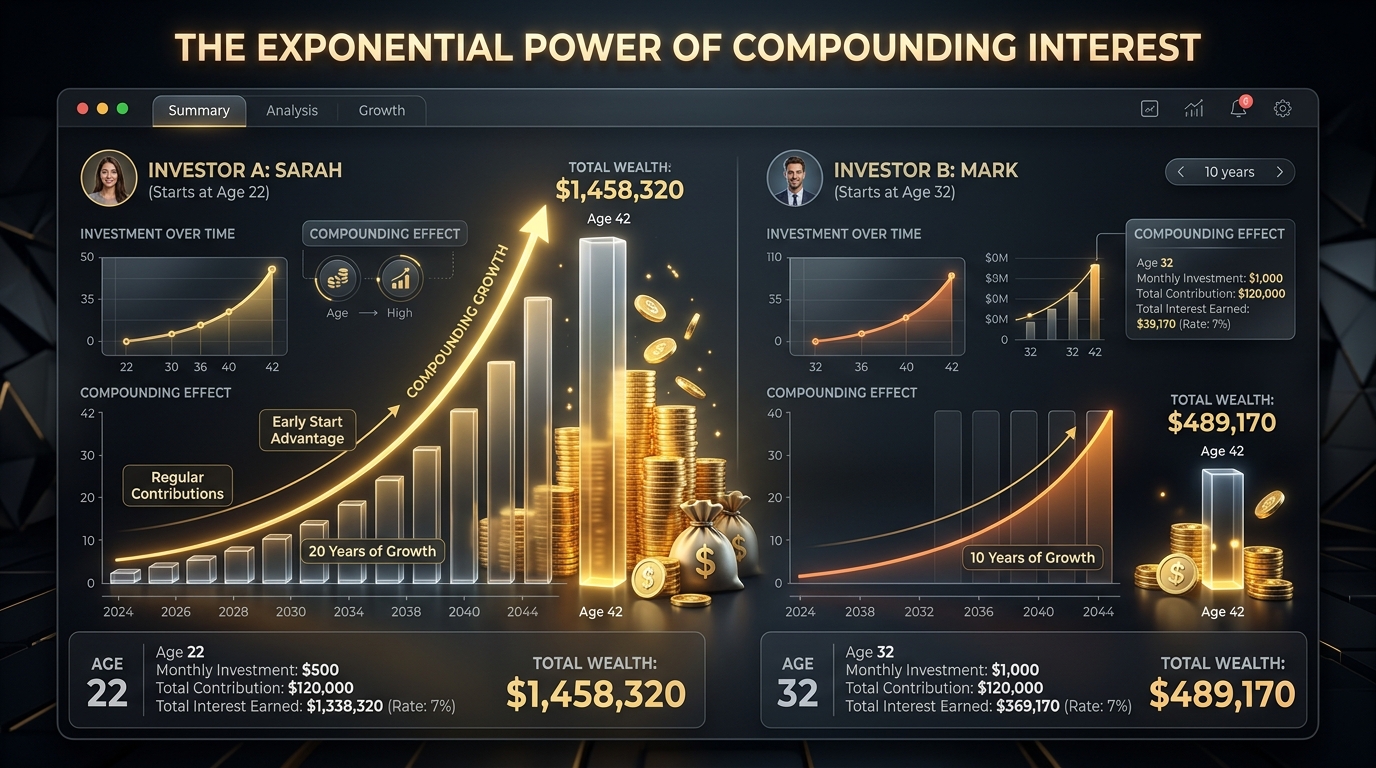
Visualize how boring monthly investing creates life-changing compounding wealth, adjusted for 6% Indian inflation.
FIRE & Net Worth Calculator
Discover your exact Financial Independence number (30x annual expenses) and audit your asset-to-debt ratio.
Indian Life Milestone & Cost Calculator
Project inflation-adjusted costs for major Indian milestones and compute required monthly investment targets.


Community Discussion
Comments (2)
The line 'Money problems are rarely just math problems; they are psychological problems wearing a financial mask' hit me deep. I was hoarding cash out of fear. Setting up my joy bucket today.
That awareness is the first step toward genuine freedom, Siddharth. When you give yourself permission to enjoy what you've earned, money stops being an anxious master and becomes a peaceful servant.
The 48-hour impulse buffer saved me ₹25,000 on a handbag I didn't actually need yesterday! Thank you Bhaway.
Haha that's incredible Meera! Delaying purchase gratification by just 48 hours eliminates 80% of regret-spending. Proud of your discipline!