The Discipline Formula: How to Stop Procrastinating, Beat Laziness, and Build Relentless Focus

Motivation is an emotional mood that disappears when things get difficult. Discipline is a trained biological habit that shows up every single day. Here is how to build it.
Listen to this Masterclass on the go
Let me describe a scene that you know all too well: You wake up in the morning full of ambition. You tell yourself, 'Today is the day! I am going to study for 3 hours, write that blog article, hit the gym, and start working on my side business.'
Then 2:00 PM rolls around. You have scrolled Instagram for 45 minutes, watched 6 random YouTube shorts, cleaned your desk twice, checked your email 10 times, and done zero actual deep work. You feel a sinking wave of guilt in your stomach. You tell yourself, 'What is wrong with me? Why am I so lazy? I'll just start fresh on Monday.'
Listen to me closely: **You are not lazy, and you are not broken.** Chronic procrastination is not a moral character flaw; it is an emotional regulation problem combined with a hyper-stimulated dopamine system. When I was recovering from severe health complications (as shared in The Human Behind My Story), I had to rebuild my entire mental discipline from scratch. Here is the exact science-backed system that helped me regain relentless focus.
The 4-Stage Operating System: The Discipline Formula: How to Stop Procrastinating, Beat Laziness, and Build Relentless Focus
Tap each stage below to explore the chronological step-by-step framework:
Acknowledge where energy and focus are leaking.
Discover how prolonged health battles taught me the power of patient compounding, stoic daily discipline, and never giving up.
Read The Human Behind StoryFocus Check: You have a major project due this week, but you're sitting on the couch scrolling reels. How do you break the trance?
Tap the option that matches your current intuition:
1. The Motivation Myth: Why Waiting to 'Feel Like It' Keeps You Trapped
Why 90% Struggle vs How the Top 10% Win
- ✕Chasing daily hype, impulsive shortcuts, and emotional overreaction.
- ✕Operating without clear boundaries or written mathematical rules.
- ✕Giving up after 2 weeks when instant dopamine gratification fades.
- ✓Automated daily discipline that compounds quietly in the background.
- ✓Unshakable emotional calm during temporary setbacks or market dips.
- ✓Staying in the game for decades to unlock exponential compounding wealth.
Amateurs wait for motivation before taking action. Professionals take action, and motivation follows as a byproduct. Motivation is a fleeting neurochemical state governed by dopamine and cortisol. It shows up when a project is shiny and new, but evaporates the moment you hit difficult debugging sessions, tedious paperwork, or exhausting routines.
Discipline, on the other hand, is the ability to execute what needs to be done regardless of your current emotional mood. When I was recovering from severe health complications—as shared in My Story—I could not wait to 'feel like' doing physical therapy or studying systems. I had to show up because my future depended on it.
2. The Dopamine Reset: Why Your Phone Is Stealing Your Ambition
Why is it so hard to read a book or write code for 45 minutes, but effortless to scroll TikTok or Instagram for 3 hours? Because social media apps deliver instant, variable micro-bursts of dopamine with zero physical effort. When your brain gets used to super-normal dopamine hits every 6 seconds, normal high-value activities (studying, building, investing) feel intolerably boring.
Smart Doubt Clearing AssistantLIVE AI
इस आर्टिकल को पढ़ते समय कोई भी सवाल या शंका हो, सीधे यहाँ पूछें:
To fix your focus, implement simple environmental constraints:
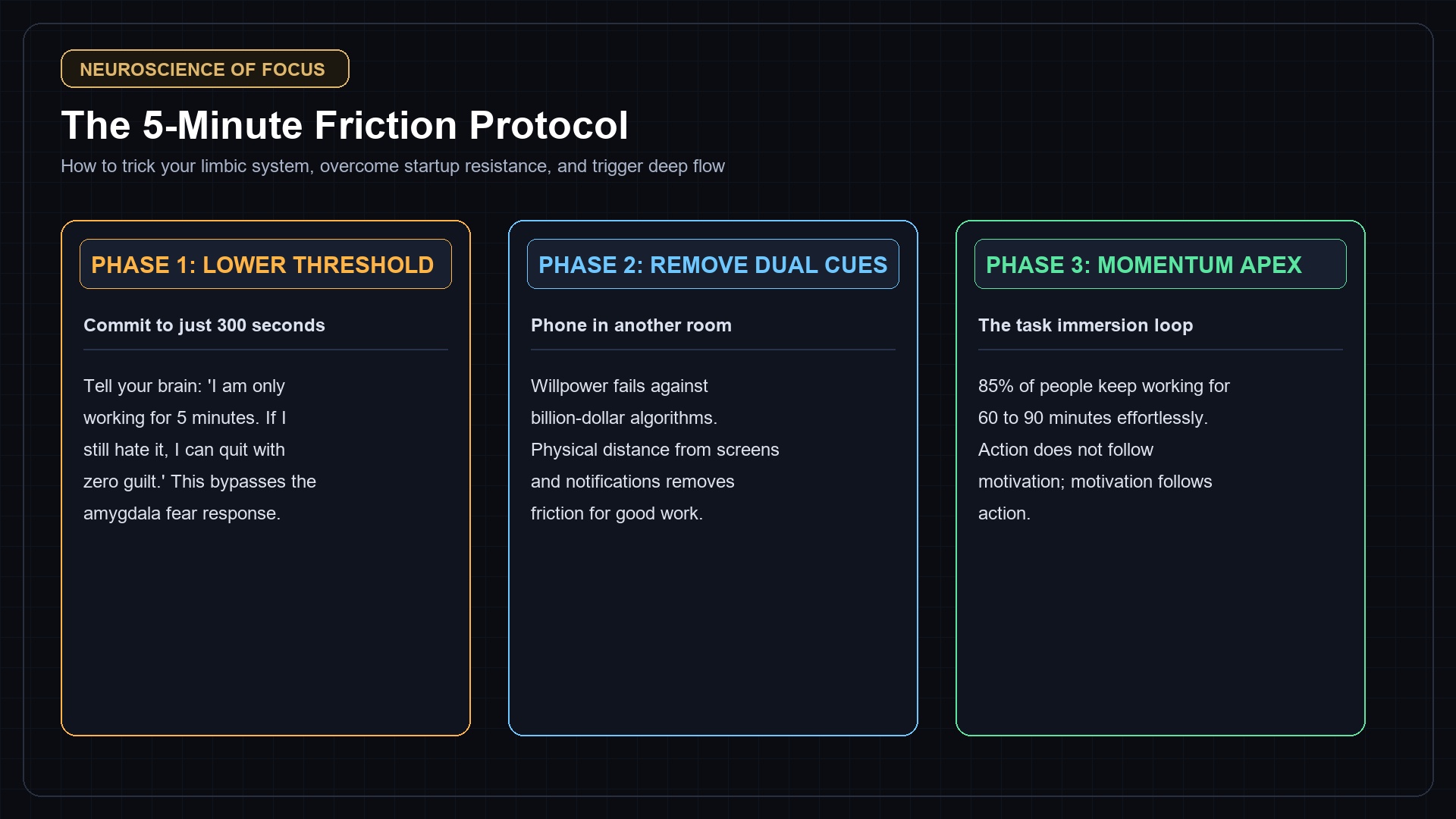
- Phone in Another Room During Deep Work: Out of sight is out of mind. Merely having your smartphone on your desk reduces cognitive performance by 20% even if it is turned off.
- Use Instrumental Focus Audio: Play lyric-free lo-fi soundscapes from Bhaway Beats to give your brain a calm, steady auditory anchor.
- One Screen, One Tab: Close the 40 open browser tabs. Multitasking is an illusion; it is simply rapid, exhausting context switching.
The 4-Phase Friction Elimination Blueprint
Break paralysis and build quiet momentum through environmental psychology. Need a daily productivity schedule? Chat with BB Digital Twin.
Physical & Digital Sensory De-Clutter
Put your phone in another room or inside a drawer. Close all irrelevant browser tabs. When temptation requires physical effort, willpower doesn't have to fight.
The 5-Minute Micro-Commitment
Give yourself permission to stop after 5 minutes. The human brain resists big mountains, but willingly starts a 5-minute warm-up. Action produces motivation, not the other way around.
90-Minute Uninterrupted Sprint Blocks
Work in protected 90-minute blocks with calming lo-fi music. Human focus naturally peaks in ultradian rhythms; honor the natural flow cycle and rest for 15 minutes after.
Lock In Tomorrow's 2 Non-Negotiables
Before shutting down your laptop, write down the 2 most important outcomes for tomorrow on an index card. Wake up with instant clarity and zero morning decision fatigue.
"You don't have to be great to start, but you have to start to be great."
"Motivation is an emotional mood that disappears when things get difficult. Discipline is a trained biological ..."
— Bhaway Bhalla • System Principle
3. Bhaway's Question of the Day & Your Action Challenge
Here is my personal question for you today: **What is ONE important task you've been putting off for days that you can do for just 5 minutes right now?**
Whenever I procrastinate on a massive software deployment or music composition session at Bhaway Beats, I just open the project file and rename one track. That tiny 10-second action breaks the paralysis every time. Tell me your 5-minute task in the comments below!
3. The 90-Minute Monk Block: How Top Builders Produce 8 Hours of Work Before Noon
Let me share the single highest-leverage productivity protocol I learned while managing complex enterprise engineering deployments (detailed in My Professional Resume): **The 90-Minute Monk Block.** Human ultradian rhythms naturally cycle through peaks of intense mental alertness followed by biological fatigue every 90 to 120 minutes. Trying to work with high focus for 8 uninterrupted hours is biologically impossible; your prefrontal cortex burns out by hour three.
Instead, structure your day around two sacred 90-minute blocks of deep execution:
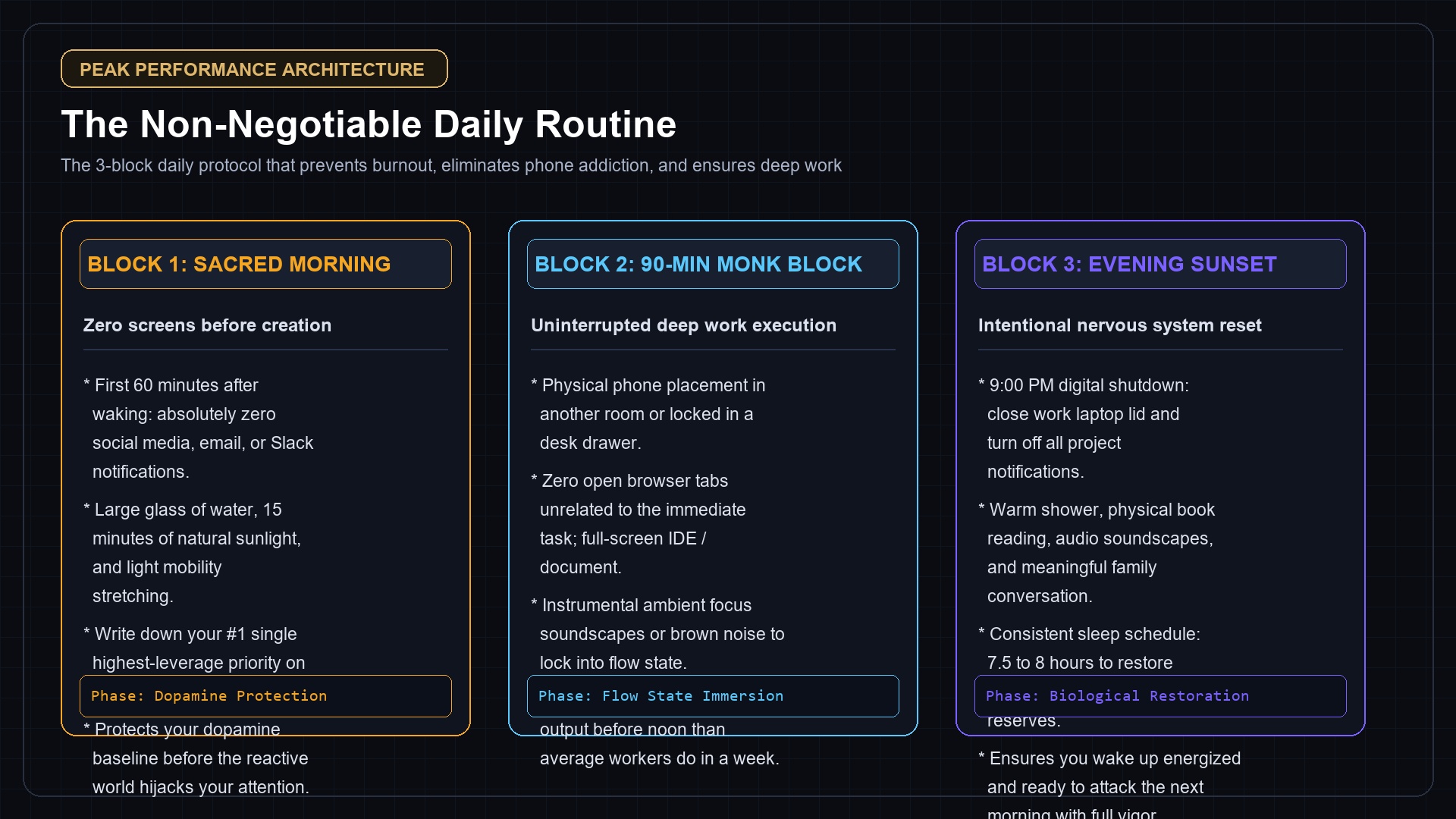
- Monk Block 1 (9:00 AM – 10:30 AM): Tackle your #1 hardest, most complex bottleneck of the day (writing, coding, strategic planning, or system architecture). Zero notifications, zero email, zero phone.
- Restorative Buffer (10:30 AM – 11:15 AM): Step completely away from screens. Drink a large glass of water, do 10 minutes of light mobility stretching, or go for a brisk walk in natural sunlight.
- Monk Block 2 (11:15 AM – 12:45 PM): Execute secondary high-leverage deliverables. By 1:00 PM, you have accomplished more needle-moving progress than 90% of office workers achieve in an entire 40-hour week.
- Soundtrack Your Flow: Use lyric-free, ambient binaural soundscapes from Bhaway Beats to give your auditory cortex a steady, non-distracting rhythm.
For the next 7 days, keep your phone outside your bedroom at night. Do not look at any screen for the first 45 minutes after waking up. Protect your dopamine baseline before the reactive digital world hijacks your peace.
Ask BB Digital Twin About Habit Systems4. Rebuilding Self-Trust: The Rule of Never Missing Twice
When people fall off their workout routine, eat junk food, or procrastinate on a deadline, they often spiral into self-loathing: 'I ruined my streak, I have zero willpower, what is the point?' They turn a minor 1-day slip into a 3-week binge of avoidance.
Remember James Clear's golden law of habit formation: **Missing once is an accident; missing twice is the start of a new habit.** You are human. Emergencies happen, energy dips, and unforeseen crises strike (as I lived through in The Human Behind My Story). When you stumble, do not beat yourself up. Smile, forgive yourself instantly, and make sure that you show up the very next day. Self-trust is built by keeping promises to yourself, one day at a time. If you want structured accountability in scaling your venture, reach out at Work With Me.
Where Should You Focus Your Energy First?
Click any quadrant to reveal high-leverage execution priorities:
Automate your basic routines today (auto-SIP, room rent sub-limit audit, muting toxic notifications).
Skill-stacking AI automation, restructuring portfolio, setting deep-work boundaries with family/partner.
Checking monthly statements, standard car checkup, weekly housekeeping habits.
Overthinking past decisions, arguing on social media comments, timing daily stock market fluctuations.

Bhaway is a systems builder, AI architect, and digital media founder. Having managed enterprise technical operations across Concentrix (Dell & Uber) and launched platforms like AI Is Everywhere and PromptLagao, he documents first-principles frameworks across human relationships, compounding wealth, and AI leverage.
Stay Connected Inside Bhaway's Digital Headquarters
Every system, brand, and framework discussed in this article is actively maintained and operated in public. Continue your exploration:
Ask BB • Article Explainer & Summary
Interactive AI breakdown for "The Discipline Formula: How to Stop Procrasti..."
Motivation is an emotional mood that disappears when things get difficult. Discipline is a trained biological habit that shows up every single day. Here is how to build it.
- •The 5-Minute Micro-Action Rule: Motivation follows action, not vice versa. Commit to just 5 minutes of focused effort—putting on gym shoes or opening a blank doc—to eliminate startup friction.
- •Environment Design Beats Willpower: Willpower is a depletable biological battery. Remove friction for good habits (clear desk, focus audio) and increase friction for bad habits (phone outside the bedroom).
- •Rebuild the Self-Trust Protocol: Never break a promise you make to yourself. Start with tiny, unbreakable daily commitments to re-establish confidence and self-respect.
What Should I Read Next?
You just finished exploring "The Discipline Formula: How to Stop Procrastinating, Beat Laziness, and Build Relentless Focus". To maximize your retention and avoid fragmented reading, follow this structured 3-step sequence:
Get 1 Practical Idea Daily.
No spam, no promotional fluff. A 2-minute actionable blueprint on modern relationships, quiet wealth compounding, or AI execution delivered directly to your inbox every morning.
FAQ
Frequently Asked Questions
1. Why do I procrastinate even when I know a task is urgent and important?
Procrastination is rarely about laziness; it is an emotional regulation problem. When a task feels huge, ambiguous, or scary (fear of failure or perfectionism), your brain's amygdala treats it like a threat and seeks instant relief through cheap dopamine (scrolling social media).
2. What is the 5-Minute Rule and why does it work so effectively?
The 5-Minute Rule says: commit to working on the task for just 300 seconds. If you still hate it after 5 minutes, you have full permission to stop. 85% of the time, overcoming that initial 5-minute startup friction is all your brain needs to enter deep flow.
3. Why does relying on willpower always lead to burnout and failure?
Willpower is a depletable biological battery. If you rely on raw willpower to resist checking your phone or eating junk food, you will fail by 4:00 PM when decision fatigue sets in. Environment design (putting the phone in another room) beats willpower every time.
4. What is a 'Dopamine Reset' and how do I do one in daily life?
A dopamine reset reduces hyper-stimulating artificial inputs (TikTok, reels, gaming, sugar) so your brain can find normal, high-value tasks (reading, coding, studying) enjoyable again. Start with a 60-minute screen-free morning routine and keep phones outside the bedroom.
5. How do I rebuild self-trust after breaking promises to myself for years?
Start with ridiculously small commitments that are impossible to fail: drinking one glass of water upon waking, reading 2 pages of a book, or doing 5 pushups. When you keep tiny promises consistently for 14 days, your self-esteem and identity naturally reset.
6. What should I do on days when I feel zero motivation to do anything?
Lower the threshold to the absolute minimum: put on your workout sneakers, open the code editor, or write one sentence. Motivation does not precede action; motivation is the biological reward released AFTER you initiate action.
7. How does listening to lyric-free music or lo-fi soundscapes help with focus?
Instrumental focus audio provides a steady auditory anchor that shields your brain from external distractions and prevents subconscious mind-wandering. Check out the focus soundscapes produced by Bhaway Beats.
8. What is the optimal morning routine for high focus and productivity?
Keep it under 3 steps: 1) Hydrate with a large glass of water, 2) Get 10 minutes of natural morning sunlight or physical movement, and 3) Complete your most critical 90-minute deep work session before opening email or social media.
9. How do I recover when I break my streak or fall off track for a few days?
Adopt the 'Never Miss Twice' rule: Missing one day is an accident; missing two days is the beginning of a new bad habit. Forgive yourself immediately, eliminate the guilt, and execute one small win tomorrow morning.
10. How did Bhaway build discipline during his long health recovery?
Read The Human Behind Story on our homepage to discover how prolonged health isolation taught Bhaway the power of patient compounding, quiet resilience, and daily stoic focus.
Topic Tags
Recommended Interactive Tools For You
Put the concepts in this article into immediate practice. Zero paywalls, instant calculations, and confidential browser-local analysis.
Deep Work & Daily Focus Capacity
Audit your daily flow state capacity, context-switching leaks, and build 4 hours of uninterrupted execution.
Dopamine Addiction & Screentime Test
Diagnose compulsive short-form video consumption, digital fatigue, and reset your dopamine receptors.
3 AM Overthinking Cognitive Meter
Assess your racing thoughts, cognitive looping index, and implement a sleep and grounding protocol.
Nervous System Burnout Diagnostic
Check your nervous system overload stage, emotional exhaustion, and restorative boundary requirements.



Community Discussion
Comments (2)
The 5-minute rule actually worked on my gym workout today. Just putting on my shoes broke the paralysis. Thank you for writing this Bhaway!
The first 5 minutes are 90% of the battle, Vikram! Your brain is wired to conserve energy, but once you break inertia, momentum takes over. Proud of you!
Putting my phone in the kitchen while studying completely transformed my afternoon focus. It's crazy how much friction that removed.
Environment design beats willpower every single time, Ananya. We can't fight billion-dollar dopamine algorithms with raw willpower alone; we have to change the room!