The Frictionless Habit Architecture: How High Performers Build Iron Discipline Without Relying on Willpower

Stop beating yourself up for having 'weak willpower.' High performers don't have superhero self-control; they have frictionless systems that make good habits inevitable and bad habits difficult. Here is the engineering blueprint.
Disclaimer: This guide provides behavioral architecture and habit engineering frameworks based on cognitive psychology and personal operational experience. Adapt these systems according to your personal biological rhythms.
Listen to this Masterclass on the go
Let me ask you an honest question: How many times have you gone to bed on a Sunday night feeling like an absolute warrior, filled with motivational adrenaline, promising yourself: *'Starting tomorrow morning, everything changes. I am waking up at 5:00 AM, drinking green juice, coding for 3 hours, working out, meditating, and reading 50 pages'*, only to find yourself by Wednesday evening collapsed on the couch, staring at Instagram reels with an empty bag of chips, feeling like a complete failure?
If you have lived that cycle once, you have lived it a hundred times. And here is what your inner critic immediately tells you: *'I am lazy. I have no discipline. I lack willpower.'* Let me tell you right here, friend to friend: **Your willpower is not broken. Your system is broken.** Relying on raw willpower to build a life is like trying to drive a car from Delhi to Mumbai using only a cup of lighter fluid. It gives you a quick, fiery burst of energy, and then leaves you stranded in the middle of the highway.
In my journey building software systems, scaling digital operations across My Professional Journey, and launching creative ventures like PromptLagao, I quickly learned that the human brain is a conservation machine. It will always take the path of least physical and cognitive resistance. If you want iron discipline, you don't fight human nature—you engineer the environment so that the right action requires zero friction.
The 4-Stage Operating System: The Frictionless Habit Architecture: How High Performers Build Iron Discipline Without Relying on Willpower
Tap each stage below to explore the chronological step-by-step framework:
Acknowledge where energy and focus are leaking.
Explore our interactive BB Digital Twin for customized daily routine audits and instant micro-habit suggestions tailored to your work style.
Ask BB for a Habit Audit1. The Anatomy of Friction: Why Willpower Always Loses to Design
In behavioral psychology, every action you take has an 'activation energy'—the amount of mental and physical effort required to initiate the behavior. Consider how easy it is to scroll TikTok or YouTube Shorts: your phone is in your pocket, one swipe unlocks the screen, and within 0.8 seconds, millions of dollars of algorithmic engineering flood your brain with cheap dopamine. Activation energy: nearly zero.
Now compare that to writing code, studying a difficult technical textbook, or going to the gym: your running shoes are buried in a dusty closet, the gym is 20 minutes away, it is cold outside, and your brain has to make 14 separate decisions before your foot hits the treadmill. Activation energy: immense. When the clock strikes 7:00 PM after a stressful workday, your exhausted prefrontal cortex will pick low activation energy every single time.
Why 90% Struggle vs How the Top 10% Win
- ✕Chasing daily hype, impulsive shortcuts, and emotional overreaction.
- ✕Operating without clear boundaries or written mathematical rules.
- ✕Giving up after 2 weeks when instant dopamine gratification fades.
- ✓Automated daily discipline that compounds quietly in the background.
- ✓Unshakable emotional calm during temporary setbacks or market dips.
- ✓Staying in the game for decades to unlock exponential compounding wealth.
Daily Friction Test: When you abandon a positive habit during a busy week, what is the most common reason?
Tap the option that matches your current intuition:
2. The 20-Second Rule: Weaponizing Friction in Both Directions
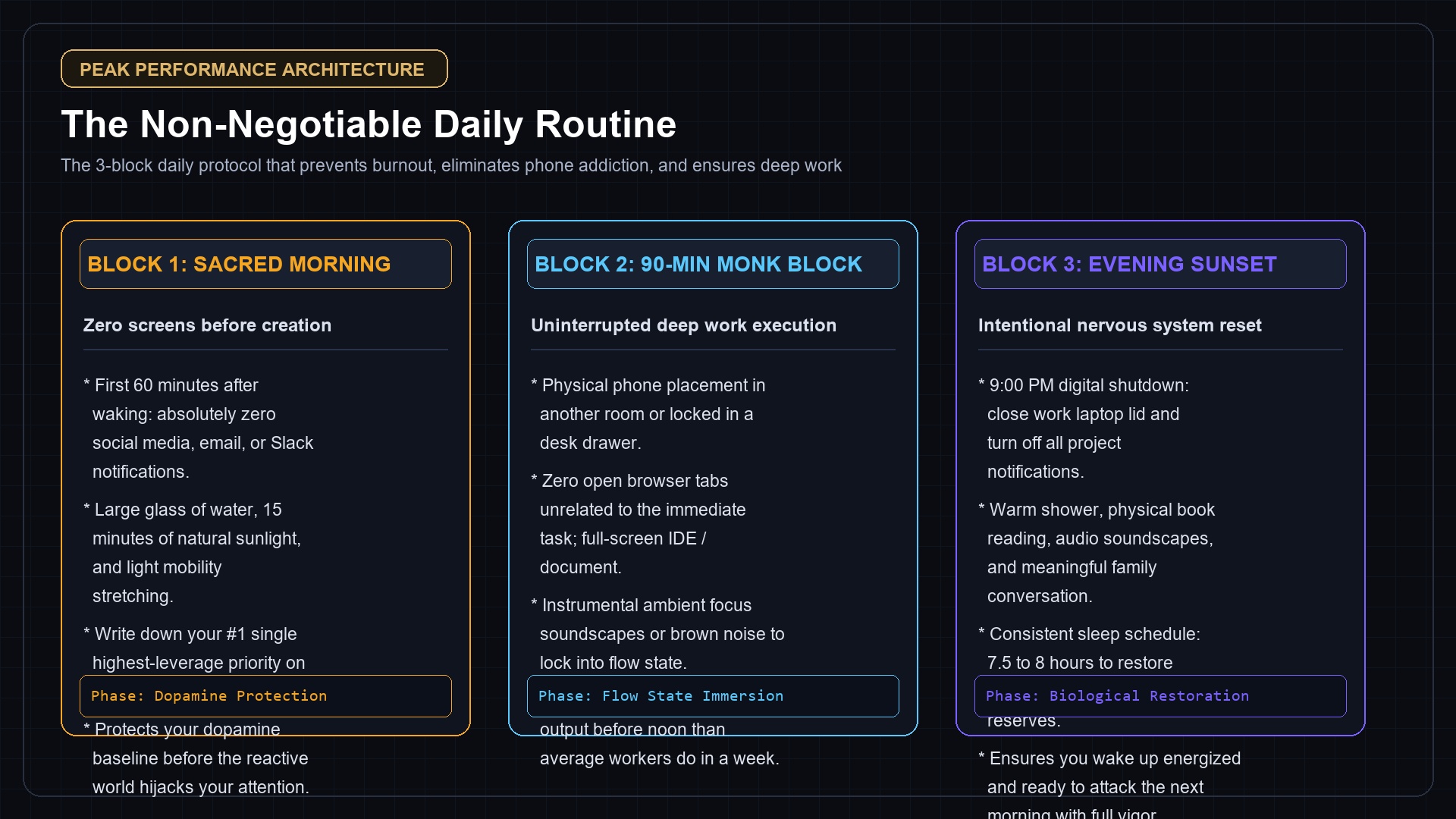
Shawn Achor, a Harvard researcher, popularized a brilliantly simple concept known as the '20-Second Rule'. The premise is straightforward: **Make positive habits 20 seconds easier to start, and make destructive habits 20 seconds harder to engage with.** That tiny 20-second delta is usually enough for your conscious brain to override impulsive subconscious reflexes.
The Dopamine Fast Protocol: Breaking the Cheap Stimulation Loop
Smart Doubt Clearing AssistantLIVE AI
इस आर्टिकल को पढ़ते समय कोई भी सवाल या शंका हो, सीधे यहाँ पूछें:
Have you ever wondered why sitting down to write code, read a book, or study feels painfully boring after 20 minutes of scrolling social media? It is not because the work is inherently torturous; it is because you just exposed your neural receptors to a level of cheap, effortless dopamine that does not exist in nature. In evolutionary biology, dopamine is the chemical of pursuit and motivation. When you get infinite novelty for zero physical exertion, your brain's baseline sensitivity recalibrates downward. Meaningful work suddenly feels as dry as sand.
To restore the natural pleasure of deep craftsmanship, high performers implement a weekly 'Dopamine Reset Protocol'. Pick one weekend morning—say, Saturday from 8:00 AM to 1:00 PM—and turn off all screens, music, and podcasts. Go for a walk, cook breakfast in silence, sit on your balcony with a notebook. The first 45 minutes feel agonizingly restless. But by hour three, something magical happens: your mind settles, your natural curiosity wakes up, and even a difficult technical challenge feels like a thrilling puzzle rather than a chore.
The 4-Quadrant Habit Replacement Principle
A fundamental law of neurobiology is that you can never truly delete a neural habit loop; you can only substitute its routine while preserving the underlying cue and reward. If you have a bad habit of reaching for your phone whenever work gets slightly frustrating, your brain is seeking a momentary relief from cognitive tension. If you try to fight that urge with pure grit, tension builds until you snap. Instead, replace the routine: keep a stress ball on your desk, or stand up and do 10 deep belly breaths. You satisfy the brain's need for release without forfeiting your attention to the algorithm.
How to Add Friction to Distractions
"Stop beating yourself up for having 'weak willpower.' High performers don't have superhero self-control; they ..."
— Bhaway Bhalla • System Principle
If you waste 2 hours every night scrolling your phone in bed, don't rely on self-control. Leave your phone charger in the kitchen. Buy a ₹500 analog alarm clock for your nightstand. If you want to check your phone at 11:30 PM, you now have to physically get out of bed, walk into the cold hallway, and stand in the kitchen. That simple physical friction cuts evening smartphone addiction by 85%.
How to Remove Friction from Deep Craft
If you want to write or code every morning before your day job begins, set up the battlefield the night before. Close all browser tabs except your IDE or draft document. Leave your water bottle and notebook on your clean desk. When you sit down with your morning tea, your fingers are already on the keys. You don't have to 'decide' to work—you are already inside the work.
3. Habit Stacking: The Biological Anchor Formula
Your brain already has hundreds of automated neurological loops that you execute daily without a shred of willpower: brushing your teeth, pouring hot water into your mug, putting on your shoes, or turning off the lights. In James Clear's groundbreaking research on habits, he popularized 'Habit Stacking'—linking a new desired behavior to an unbreakable existing anchor.
| Existing Biological Anchor | New Micro-Habit (Frictionless) | Compounded Yearly Result |
|---|---|---|
| While my morning coffee is brewing (3 mins) | Do 20 pushups or deep stretching right by the counter | 7,300 pushups per year with zero dedicated gym time |
| Immediately after closing my work laptop at 6 PM | Write down tomorrow's single most important needle-mover | Zero evening anxiety and instant focus the next morning |
| The moment my head touches the pillow | Name 3 specific moments from the day I am grateful for | Retrains the brain out of chronic hyper-vigilance into peace |
| Right after opening my morning IDE | Spend 15 minutes reviewing system architecture or docs | 90 hours of compounding technical mastery every year |
| When I sit down for lunch | Drink a tall 500ml glass of fresh water before taking a bite | 180+ liters of optimal cellular hydration |
4. The 4-Pillar Daily Discipline Architecture
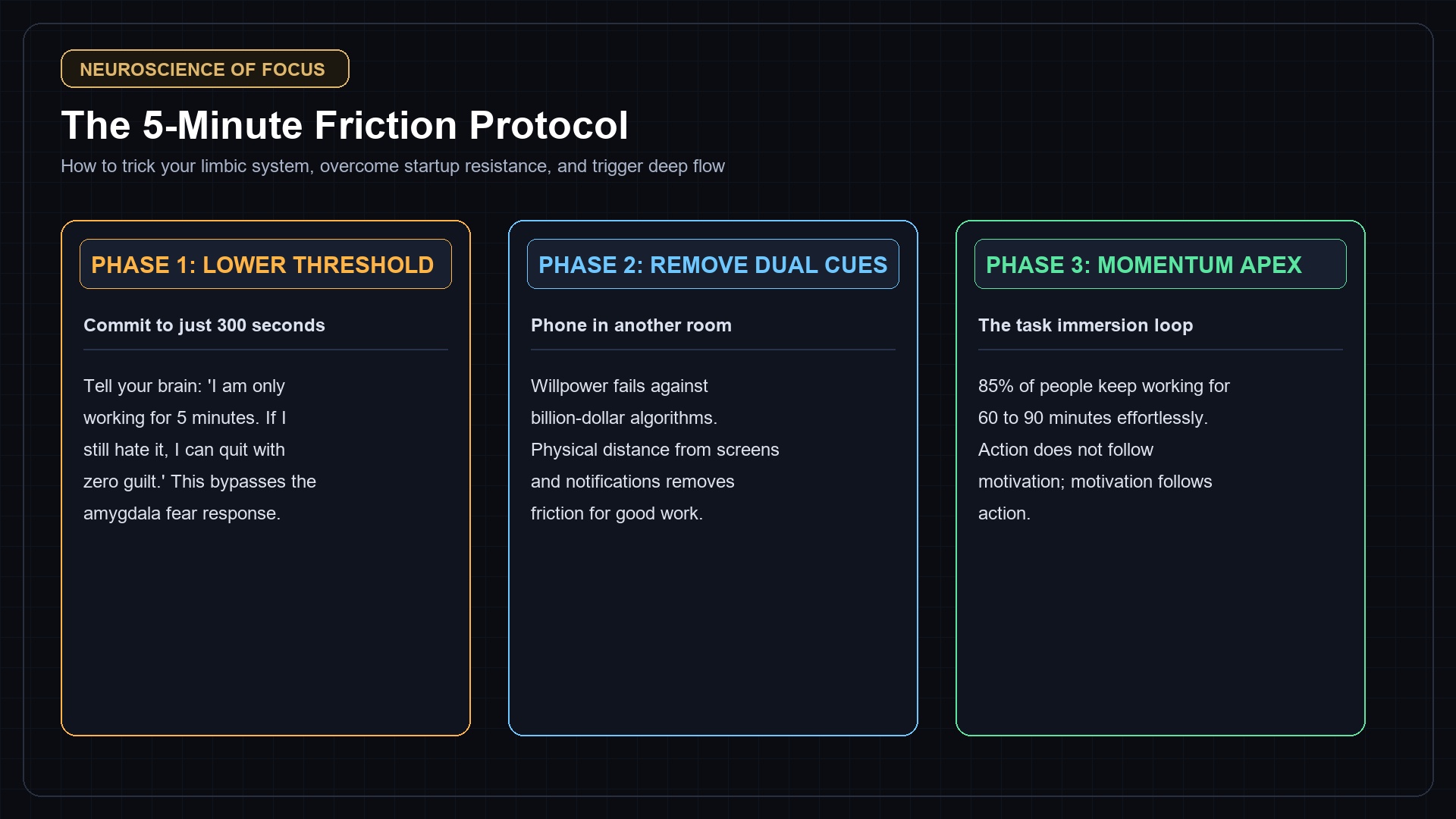
True discipline is not rigid military punishment; it is a calm, predictable rhythm that supports your creative soul. Here is the 4-pillar architecture I use to keep my productivity, mental health, and physical energy aligned:
The High-Performance Habit System
Four synchronized pillars for sustainable, burn-out-free daily consistency
The Zero-Decision Morning Gateway
Protect the first 60 minutes after waking from digital inputs. No news, no WhatsApp, no email. Drink water, get morning sunlight, and let your subconscious complete its morning boot sequence in peace.
The Single-Task Deep Work Anchor
Identify the ONE task that, if finished today, makes the day an undeniable win. Attack this needle-mover before checking administrative messages or attending status meetings.
The Midday Biological Reset
Step away from screens for 20 minutes between 1:00 PM and 2:30 PM. A brisk outdoor walk without headphones resets cognitive fatigue and restores prefrontal stamina for afternoon tasks.
The Evening RAM Clear & Shutdown Ritual
Close all browser windows, jot down unresolved thoughts on a physical scratchpad, and declare your workday officially closed. Your brain cannot rest if open loops remain untracked.
"You do not rise to the level of your goals. You fall to the level of your systems. A goal is just a daydream until the environment makes the execution frictionless."
5. The 'Never Miss Twice' Rule: Healing From Habit Guilt
Here is the biggest difference between amateurs and master builders: Amateurs think discipline means a 365-day unbroken streak of perfection. The moment an unexpected fever hits, a family emergency arises, or a brutal travel schedule breaks their streak, they feel shame, declare themselves a failure, and abandon the habit for three months.
Master builders live by the **Never Miss Twice Rule**. Missing a day happens to every human being on earth. Life is messy, emergencies occur, and energy fluctuates. One missed day is an accident; two missed days is the start of a brand new, destructive habit. If you miss your workout on Tuesday because of a late client deadline, your sole mission on Wednesday is to do even a tiny 10-minute mobility session. Protect the identity of showing up.
As we discussed in our deep dive on Peaceful Living & Emotional Calm, treating yourself with compassionate patience is not weakness—it is the biological fuel that enables lifelong resilience.
Your 24-Hour Implementation Blueprint
- Pick ONE habit you have been struggling to build for the past 6 months. Do not pick five; pick exactly one.
- Shrink it down using the 2-Minute Rule until it feels ridiculously easy (e.g., reading 1 page of a book, writing 3 lines of code, doing 5 squats).
- Identify an existing unbreakable daily anchor to stack it onto (e.g., 'After I pour my morning water, I will...').
- Move one major digital temptation out of your immediate field of vision before you sleep tonight.
- Check out our foundational guide on How to Beat Procrastination and Build Daily Discipline for companion strategies.
Where Should You Focus Your Energy First?
Click any quadrant to reveal high-leverage execution priorities:
Automate your basic routines today (auto-SIP, room rent sub-limit audit, muting toxic notifications).
Skill-stacking AI automation, restructuring portfolio, setting deep-work boundaries with family/partner.
Checking monthly statements, standard car checkup, weekly housekeeping habits.
Overthinking past decisions, arguing on social media comments, timing daily stock market fluctuations.

Bhaway is a systems builder, AI architect, and digital media founder. Having managed enterprise technical operations across Concentrix (Dell & Uber) and launched platforms like AI Is Everywhere and PromptLagao, he documents first-principles frameworks across human relationships, compounding wealth, and AI leverage.
Stay Connected Inside Bhaway's Digital Headquarters
Every system, brand, and framework discussed in this article is actively maintained and operated in public. Continue your exploration:
Ask BB • Article Explainer & Summary
Interactive AI breakdown for "The Frictionless Habit Architecture: How High..."
Stop beating yourself up for having 'weak willpower.' High performers don't have superhero self-control; they have frictionless systems that make good habits inevitable and bad habits difficult. Here is the engineering blueprint.
- •Willpower is an exhaustible cognitive resource: attempting to force good habits through brute emotional force leads to decision fatigue and inevitable burnout by Thursday night.
- •Environmental design is the ultimate lever: increasing the physical and digital friction for destructive habits (20-second rule) while reducing friction for high-value actions makes discipline effortless.
- •The 'Never Miss Twice' principle protects consistency: high performers don't maintain perfection; they maintain resilience by never allowing a single off-day to turn into a multi-week regression.
What Should I Read Next?
You just finished exploring "The Frictionless Habit Architecture: How High Performers Build Iron Discipline Without Relying on Willpower". To maximize your retention and avoid fragmented reading, follow this structured 3-step sequence:
Get 1 Practical Idea Daily.
No spam, no promotional fluff. A 2-minute actionable blueprint on modern relationships, quiet wealth compounding, or AI execution delivered directly to your inbox every morning.
FAQ
Frequently Asked Questions
What if my work schedule changes every single day and I have no fixed routine?
Focus on 'Sequence Stacking' rather than 'Time Blocking'. Instead of saying 'I will meditate at 7:00 AM', say 'Whenever I wake up, the very next thing I do is drink water and meditate for 5 minutes.' Anchoring habits to sequences allows your discipline to travel with you regardless of erratic calendar hours.
How long does it realistically take to make a new habit feel completely automatic?
A famous University College London study found that on average, it takes 66 days for a new behavior to become automatic, varying from 18 to 254 days depending on complexity. Do not expect effortless flow in the first 21 days; focus on lowering friction until momentum takes over.
Can this frictionless system work for someone diagnosed with ADHD?
Yes, in fact, it is exceptionally effective for neurodivergent minds because ADHD brains struggle heavily with executive function and working memory. Externalizing cues into the physical environment (visual timers, open workspaces, removing digital clutter) bypasses the need for internal executive willpower.
Should I track my daily habits in a digital app or a physical notebook?
For most people, a simple physical notebook or wall calendar provides far superior tactile satisfaction and zero distraction risk. Opening a smartphone app to check off a habit exposes you to 20 notifications that can instantly derail your focus.
What should I do if I am completely burned out and can't even manage the 2-minute habit?
Permit yourself radical rest. Chronic burnout is a biological emergency, not laziness. Sleep 9 hours, drink electrolytes, walk in green parks, and talk to someone you trust. Once your nervous system settles, the appetite for creation and discipline returns naturally.
Topic Tags
Recommended Interactive Tools For You
Put the concepts in this article into immediate practice. Zero paywalls, instant calculations, and confidential browser-local analysis.
Deep Work & Daily Focus Capacity
Audit your daily flow state capacity, context-switching leaks, and build 4 hours of uninterrupted execution.
Dopamine Addiction & Screentime Test
Diagnose compulsive short-form video consumption, digital fatigue, and reset your dopamine receptors.
Rich By 40 & Net Worth Growth
Calculate your wealth velocity, monthly savings rate impact, and projected net worth milestone at age 40.
Nervous System Burnout Diagnostic
Check your nervous system overload stage, emotional exhaustion, and restorative boundary requirements.



Community Discussion
Comments (1)
Moving my phone charger to the kitchen completely cured my midnight doomscrolling this week. The 20-second rule is pure genius.
Environment design beats willpower every single time, Gaurav! Make good habits frictionless and bad habits inconvenient. Keep that bedroom sanctuary phone-free!