Healing Emotional Fractures: The Loving Playbook to De-Escalate Fights, Forgive Deeply, and Rebuild Trust

Ego jeetna chahti hai, par dil rishta bachana chahta hai. Aao seekhein ki kaise bina aatm-samman khoye rishte ko dubara jodte hain.
Disclaimer: This guide provides actionable conflict resolution strategies for personal relationships and professional partnerships.
Listen to this Masterclass on the go
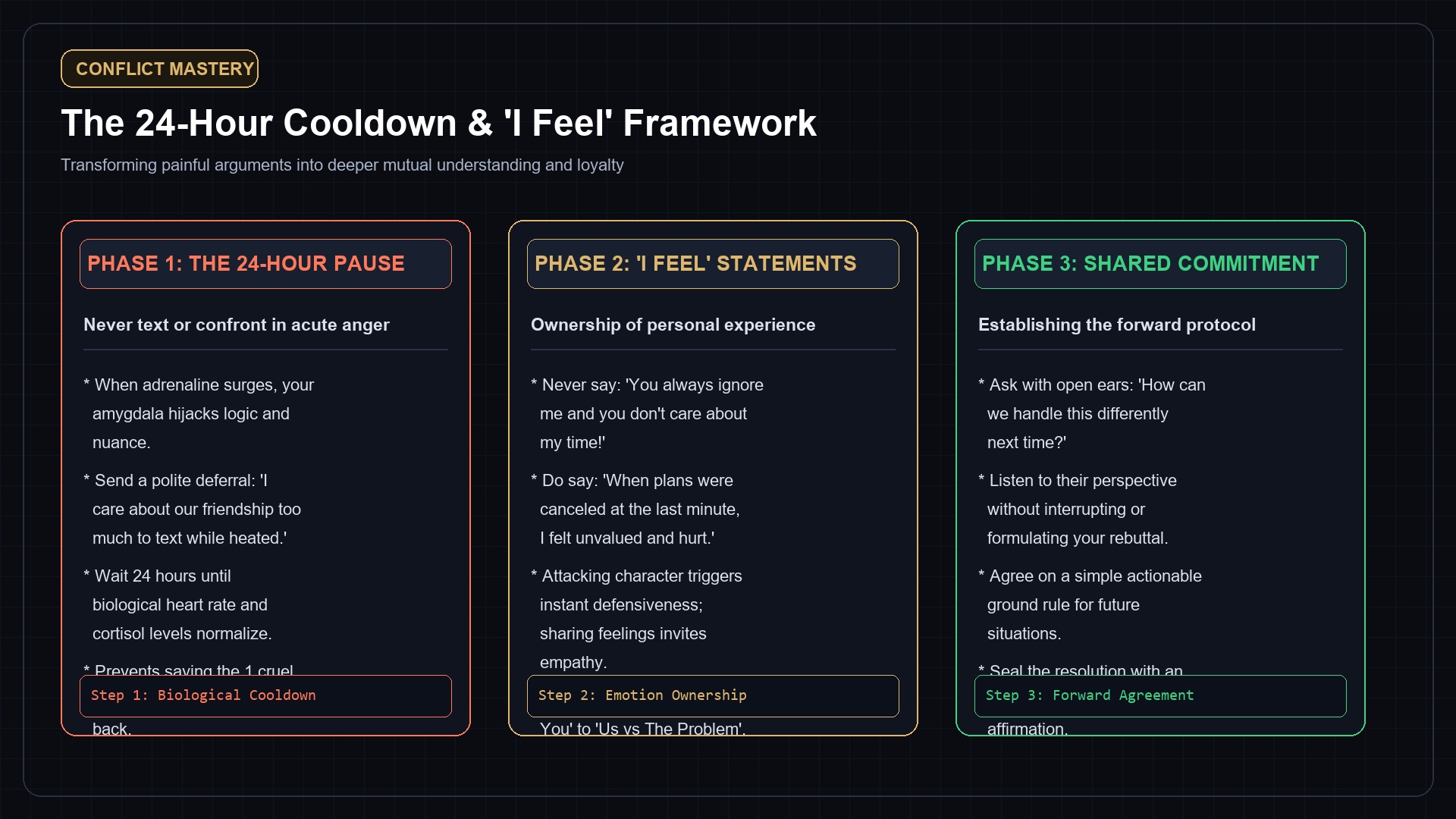
The greatest gift you can give a fractured friendship is the '24-Hour Amygdala Pause'. When a heated disagreement occurs, our primitive fight-or-flight nervous system triggers an intense desire to defend our ego and attack the other person's flaws. Never send an emotional paragraph or have a serious confrontation during this state of high biological arousal. Take a deep breath, sleep on it, and revisit the conversation when cortisol levels have dropped. True maturity is wanting to understand more than wanting to be right.
Ek chhota sa misunderstanding, ek bina soche samjhe bola gaya lafz, ya ek rude WhatsApp message... aur saalon purana rishta achanak barf ki tarah thanda pad jaata hai. Dono taraf ego hoti hai: *'Pehle woh sorry bolega, main kyun jhukun?'*
Par raat ko akele mein dil jaanta hai ki us insaan ki kami kitni khal rahi hai. Kya tumne kabhi socha hai ki kitne rishte sirf isliye toot gaye kyunki kisi ek mein yeh bolne ki himmat nahi thi: *'Yaar, mujhe bura laga, par main tumhein khona nahi chahta'?*
The 4-Stage Operating System: Healing Emotional Fractures: The Loving Playbook to De-Escalate Fights, Forgive Deeply, and Rebuild Trust
Tap each stage below to explore the chronological step-by-step framework:
Excel in your fundamental job responsibility.
Ego jeet sakti hai, par jeet ke baad kamra bilkul khali aur sunsan hota hai. Aao, main tumhein sikhata hoon ki kaise mature bano, kaise bina defensive huye baat karo, aur kaise toote hue bharose ko pehle se zyada majboot banao.
Every meaningful, long-term relationship will eventually face moments of friction. You thought a plan was confirmed; they flaked at the last minute. They made a tasteless joke about your family; you felt publicly humiliated. You felt unsupported during a major launch; they felt you became aloof and distant. Friction is not a sign that a friendship is broken; **friction is the inevitable price of admission for authentic human intimacy.**
What separates lifelong friendships from fragile acquaintances is not the absence of arguments—it is the maturity of their conflict resolution protocols. In enterprise operations and venture partnerships (like the ones we manage across My Brands), avoiding hard conversations leads to catastrophic failures. The exact same principle applies to your personal relationships.
Diagnostic Test: A close friend forgot your birthday for the second year in a row, and you feel genuinely hurt. What is the most emotionally mature way to address it?
Tap the option that matches your current intuition:
Why 90% Struggle vs How the Top 10% Win
- ✕Chasing daily hype, impulsive shortcuts, and emotional overreaction.
- ✕Operating without clear boundaries or written mathematical rules.
- ✕Giving up after 2 weeks when instant dopamine gratification fades.
- ✓Automated daily discipline that compounds quietly in the background.
- ✓Unshakable emotional calm during temporary setbacks or market dips.
- ✓Staying in the game for decades to unlock exponential compounding wealth.
"Ego jeetna chahti hai, par pyaar rishta bachana chahta hai. Faisla tumhein karna hai ki tumhein kya pyara hai."
1. The 3 Poisonous Habits That Destroy Friendship Conflict Resolution
Before we look at how to resolve conflicts, eliminate these three toxic reflexes that turn small misunderstandings into irreparable fractures:
- Poison 1 — The Kitchen Sink Technique: Instead of addressing the immediate issue (flaking on dinner), you drag up 8 unrelated grievances from 2023 ('And remember when you didn't help me move apartments?!'). Keep the scope strictly to the present issue.
- Poison 2 — The Weaponized Absolute: Never use words like 'You ALWAYS' or 'You NEVER.' These are factual exaggerations that instantly trigger the other person's defensive armor.
- Poison 3 — Fighting Over Text: Text messages lack 90% of human communication (tone of voice, facial micro-expressions, body warmth). Never attempt to resolve a high-stakes emotional disagreement over WhatsApp or iMessage.
| Destructive Approach | Constructive Reframe | Psychological Result |
|---|---|---|
| 'You always embarrass me in front of other people!' | 'When you brought up that private story at dinner, I felt exposed and hurt.' | Diffuses defensiveness; shifts focus to feelings. |
| Texting an angry 500-word paragraph at 11:30 PM. | 'Hey, there's something on my mind. Let's grab a quick tea tomorrow so we can talk through it.' | Prevents late-night misunderstandings and escalation. |
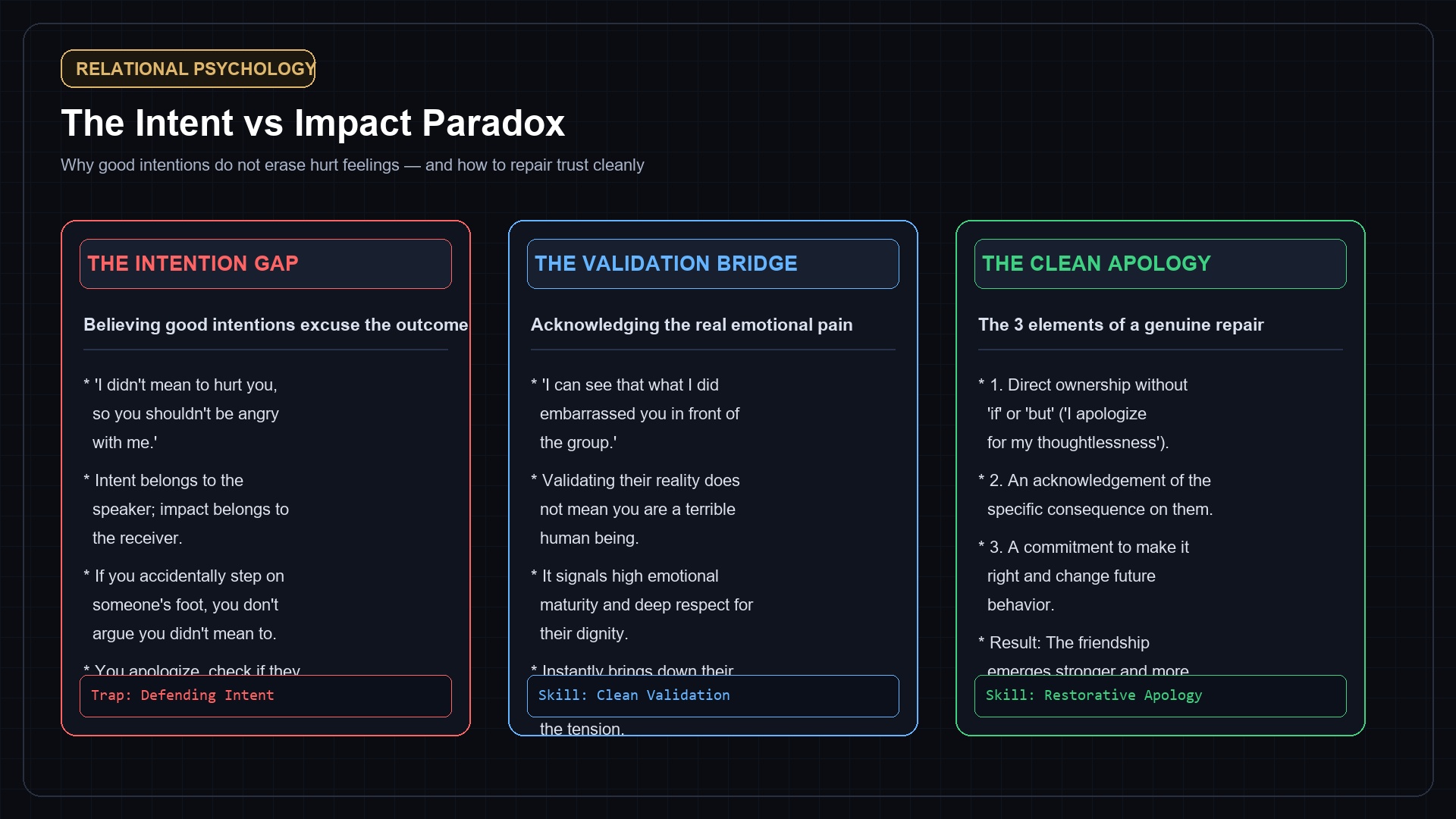
| 'I didn't mean to, so you shouldn't be mad.' | 'I see that my actions caused you pain, and I am genuinely sorry for that.' | Validates their lived reality; repairs the emotional breach. |
Smart Doubt Clearing AssistantLIVE AI
इस आर्टिकल को पढ़ते समय कोई भी सवाल या शंका हो, सीधे यहाँ पूछें:
The 4-Stage Ego-Free Conflict Repair Blueprint
Resolve painful misunderstandings with empathy and grace so friendship wins over pride. Need advice navigating a touchy topic? Ask Digital Bhaway.
The 12-Hour Emotional De-escalation Rule
Never send heated paragraphs in the heat of anger. Wait at least 12 hours until your nervous system stabilizes. Words spoken in fury leave scars that outlast the argument.
Frame Feelings Around 'I' Instead of 'You'
Accusatory statements ('You never care') immediately trigger defensiveness. Instead, say: 'I felt hurt when that happened, because our friendship means a lot to me.'
Summarize Their Hurt Before Defending Yours
Before stating your side, mirror back their perspective: 'What I understand is that you felt left out and unsupported—is that accurate?' When people feel heard, tension dissolves.
Agree on a Simple Habit Shift Moving Ahead
Agree on one practical action so the same friction doesn't repeat. Reaffirm that your mutual care and respect are vastly bigger than any momentary disagreement.
"Jab gusse ki aag thandi ho jaye, toh ek call kar lena dost. Ek chhota sa 'Kaisa hai?' saalon ki dooriyan mita deta hai."
2. The 3 Elements of an Irresistible, Genuine Apology
A fake corporate apology sounds like this: 'I'm sorry if your feelings were hurt by what happened.' (Notice the word *if*—it shifts the blame onto their sensitivity rather than your actions).
"Ego jeetna chahti hai, par dil rishta bachana chahta hai. Aao seekhein ki kaise bina aatm-samman khoye rishte ..."
— Bhaway Bhalla • System Principle
A real, transformative apology contains three non-negotiable components:
- 1. Direct Ownership: 'I apologize for my thoughtless comment.' No excuses, no blaming traffic, no pointing out what they did wrong first.
- 2. Empathic Impact Validation: 'I can see how making that joke in front of our friends undermined your confidence and embarrassed you.'
- 3. Forward Commitment: 'Moving forward, your private business stays between us. You can trust that I will protect your back in public.'
"The mark of an extraordinary friend is not someone who never makes a mistake; it is someone with the courage, humility, and love to own their mistake and make it right."
3. The Post-Conflict Reconnection Ritual: Sealing the Repair
Once the difficult conversation has ended and both parties have apologized, there is often a lingering 24-hour awkwardness. The air feels slightly fragile, and both people wonder: 'Are we really okay?'
Break the awkwardness with a deliberate **Reconnection Ritual**: send a funny inside joke meme, invite them for their favorite comfort street food, or plan a collaborative sprint. Show them through small, consistent actions that the relationship is completely safe. For professional partnership conflicts, consult our executive runbooks on My Professional Journey and Work With Me.
Ask the BB Digital Twin Console for diplomatic scripts and conflict de-escalation strategies.
Ask BB Digital Twin Anything4. The 48-Hour Filter: When to Speak Up vs When to Let It Go
Not every minor annoyance requires a 45-minute debrief. Use the **48-Hour Emotional Filter**:
- If something still bothers you 48 hours later, it is a boundary violation that must be addressed kindly.
- If it was forgotten by the next morning, it was merely temporary ego friction that you can let dissolve.
- When addressing recurring issues, frame everything as: 'You and Me vs The Problem', never 'Me vs You'.
Discover how high-stakes communication helped build resilient tech systems at AI Is Everywhere and explore The Human Behind My Story.
Where Should You Focus Your Energy First?
Click any quadrant to reveal high-leverage execution priorities:
Automate your basic routines today (auto-SIP, room rent sub-limit audit, muting toxic notifications).
Skill-stacking AI automation, restructuring portfolio, setting deep-work boundaries with family/partner.
Checking monthly statements, standard car checkup, weekly housekeeping habits.
Overthinking past decisions, arguing on social media comments, timing daily stock market fluctuations.

Bhaway is a systems builder, AI architect, and digital media founder. Having managed enterprise technical operations across Concentrix (Dell & Uber) and launched platforms like AI Is Everywhere and PromptLagao, he documents first-principles frameworks across human relationships, compounding wealth, and AI leverage.
Stay Connected Inside Bhaway's Digital Headquarters
Every system, brand, and framework discussed in this article is actively maintained and operated in public. Continue your exploration:
Ask BB • Article Explainer & Summary
Interactive AI breakdown for "Healing Emotional Fractures: The Loving Playb..."
Ego jeetna chahti hai, par dil rishta bachana chahta hai. Aao seekhein ki kaise bina aatm-samman khoye rishte ko dubara jodte hain.
- •Conflict avoidance is the silent killer of relationships: unaddressed micro-annoyances don't vanish; they ferment into toxic passive-aggressive bitterness.
- •The 24-Hour Cooldown protocol prevents adrenaline-driven cruelty: defer the discussion until cortisol and heart rates return to biological baseline.
- •The Intent vs Impact paradox: acknowledging the real emotional pain caused by your actions must precede any explanation of your good intentions.
What Should I Read Next?
You just finished exploring "Healing Emotional Fractures: The Loving Playbook to De-Escalate Fights, Forgive Deeply, and Rebuild Trust". To maximize your retention and avoid fragmented reading, follow this structured 3-step sequence:
Get 1 Practical Idea Daily.
No spam, no promotional fluff. A 2-minute actionable blueprint on modern relationships, quiet wealth compounding, or AI execution delivered directly to your inbox every morning.
FAQ
Frequently Asked Questions
Why is avoiding conflict worse than having an uncomfortable conversation?
Unspoken resentments do not disappear; they accumulate into subconscious contempt. When contempt sets in, you begin to interpret even innocent behaviors negatively, guaranteeing the eventual death of the bond.
How long should I wait before bringing up an issue that hurt me?
Wait at least 24 hours to ensure your nervous system has returned to biological baseline, but do not wait longer than 7 to 10 days. Waiting months turns an acute, fixable issue into stale, brooding resentment.
What should I do if a friend becomes defensive and attacks back when I express my feelings?
Do not escalate. Calmly state: 'I am not attacking your character; I am sharing my feelings because I care about keeping our bond clean. Let's take a breather and talk when we are both ready.'
Is it ever okay to resolve an argument over text message?
Only for minor logistical clarifications. Emotional misunderstandings should always be addressed via voice call or in person where tone, pacing, and facial warmth can prevent misinterpretation.
How do I forgive a friend when they haven't apologized?
Forgiveness is for your own freedom, not their absolution. Forgive them internally to release the emotional poison of bitterness, but adjust your future boundaries and expectations accordingly.
What is the difference between a disagreement and relational abuse?
Healthy disagreements involve two people seeking mutual understanding. Relational toxicity involves gaslighting (denying reality), character assassination, public humiliation, and weaponized silent treatments.
Can a big argument actually make a friendship stronger?
Yes! When two friends successfully navigate a painful conflict with vulnerability and mutual respect, they prove that the relationship can survive storms, which creates unshakeable mutual trust.
What should I do if mutual friends try to meddle in our private conflict?
Establish firm boundaries: 'I appreciate your concern, but Rohan and I are handling this directly between ourselves. We would love your help by keeping this private.'
How do I know when an argument has become a dealbreaker?
When the conflict reveals a fundamental divergence in core ethics, repeated betrayal of basic trust, or a total lack of empathy and remorse from the other party.
Where can I discuss difficult relationship communication strategies?
You can ask the interactive BB Digital Twin for personalized scripts and diplomatic framing for sensitive personal and professional discussions.
Topic Tags
Recommended Interactive Tools For You
Put the concepts in this article into immediate practice. Zero paywalls, instant calculations, and confidential browser-local analysis.
Relationship Health Score
Evaluate your relationship across 4 core pillars: emotional safety, trust, respect, and mutual daily effort.
Loyalty & Trust Assessment
Measure relationship stability, emotional fidelity, honesty under stress, and boundary consistency.
Modern Red Flag Scanner
Audit green, yellow, and red behavioral patterns in modern dating, texting habits, and emotional respect.
MindMatch™ Marriage & Kundli
Fuses traditional Kundli matching with financial transparency, communication styles, and family boundaries.



Community Discussion
Comments (1)
Super insightful post! The clear breakdown made it effortless to understand and apply.
Thanks Aman! Really glad this clicked for you. Let me know what you think once you try it out!