When Someone You Love is Drowning in Darkness: How to Hold Space, Listen with Love, and Never Burn Out

Jab koi apna andhere mein doob raha ho, toh use lecture mat do. Bas chupchap uske paas baith jao. Yahan seekho sahi tareeqa.
Disclaimer: This guide is intended for compassionate relational support and emotional presence. If someone you know is in acute psychological distress or expressing suicidal ideation, please connect them immediately to a qualified crisis hotline or licensed medical professional.
Listen to this Masterclass on the go
Always remember: You are not responsible for fixing their mental health. You cannot cure someone's depression through sheer emotional effort or love. What you CAN do is provide a reliable, non-judgmental presence, remind them that their feelings are valid, and gently assist them in finding professional medical or psychological support when they are ready. Protecting your own mental peace ensures you can be a steady light in their journey without burning out yourself.
Jab tumhara koi bohot kareebi dost ya family member depress hota hai, toh sabse pehli feeling aati hai laachari ki: *'Main iske liye kya karun? Yeh theek kyun nahi ho raha?'*
Aksar log unhe bolte hain: 'Bhai ghoomne chal', 'Positive soch', 'Sab theek ho jayega'. Par sach yeh hai ki yeh baatein unhe aur zyada akela aur guilt mein daal deti hain, kyunki woh chaah kar bhi positive nahi feel kar paate.
The 4-Stage Operating System: When Someone You Love is Drowning in Darkness: How to Hold Space, Listen with Love, and Never Burn Out
Tap each stage below to explore the chronological step-by-step framework:
Acknowledge where energy and focus are leaking.
Depression ko theek karne ke liye words nahi, unconditional presence chahiye hoti hai. Is guide mein, main tumhein sikhata hoon ki kaise ek majboot chhat ki tarah kisi ke sir par khade raha jata hai, bina khud tute aur bina un par dabav daale.
There are few feelings in life more helpless than watching a dear friend drown in psychological darkness. They stop replying to messages, their eyes lose their spark, they withdraw from social circles, and when you ask how they are doing, they give you a flat, hollow: 'I'm fine, just tired.' You want desperately to fix it, to pull them back into the light, but you have no idea what words will help and what words will accidentally make them feel worse.
Having lived through years of severe medical isolation and physical vulnerability (as detailed in The Human Behind My Story), I know what it feels like to sit on the other side of that table. I remember the well-meaning people who accidentally made me feel guilty with their shallow cheerfulness, and I remember the rare saints who sat in the silence with me and saved my sanity. Here is how you can be that safe harbor.
Scenario: Your best friend just lost their job and has been lying in bed depressed for 5 days. What is the most supportive message you can send them?
Tap the option that matches your current intuition:
Why 90% Struggle vs How the Top 10% Win
- ✕Chasing daily hype, impulsive shortcuts, and emotional overreaction.
- ✕Operating without clear boundaries or written mathematical rules.
- ✕Giving up after 2 weeks when instant dopamine gratification fades.
- ✓Automated daily discipline that compounds quietly in the background.
- ✓Unshakable emotional calm during temporary setbacks or market dips.
- ✓Staying in the game for decades to unlock exponential compounding wealth.
"Jab koi andhere mein doob raha ho, toh use roshni ke lecture mat do. Bas chupchap uske paas baith jao aur uska haath thaam lo."
1. The Sins of Toxic Positivity: Why Good Intentions Can Hurt
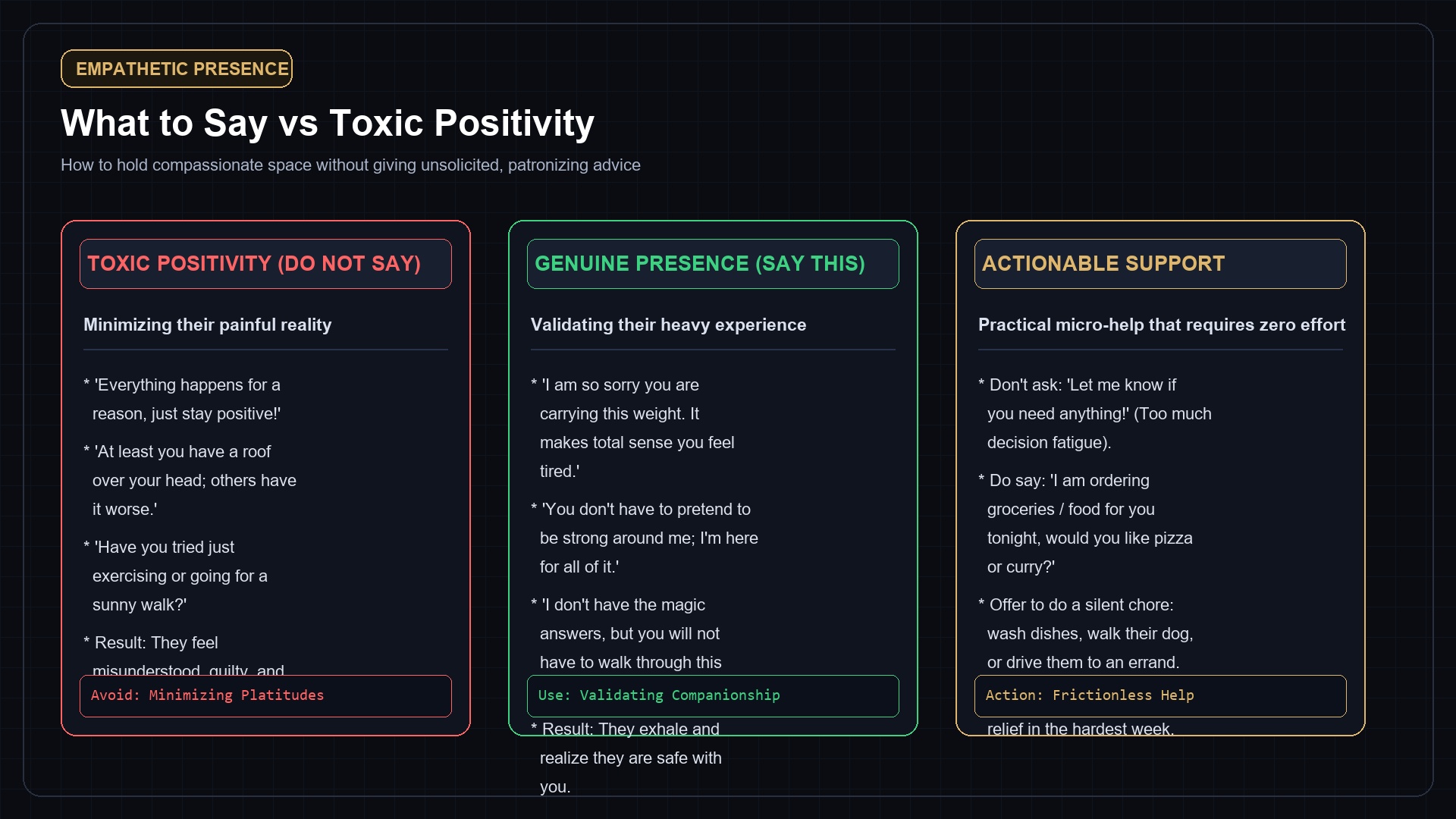
When we care about someone, their pain makes us uncomfortable. To relieve our own discomfort, we often blurt out canned Hallmark clichés: 'Stay strong!', 'Look on the bright side!', 'At least you have your health!' While spoken with loving intentions, to someone in deep depression, these phrases translate to: *'Your pain is an inconvenience to me; please hide it and put on a happy face.'*
| Toxic Positivity (Dismissive) | Empathetic Companion (Validating) | The Impact on Their Nervous System |
|---|---|---|
| 'Don't cry, it will all work out!' | 'Let the tears come; I am right here with you.' | Releases built-up cortisol; signals emotional safety. |
| 'You just need to think more positively!' | 'It makes total sense you feel overwhelmed by this.' | Removes shame and guilt; restores human dignity. |
| 'Let me know if you need anything!' | 'I am dropping groceries at your porch at 6 PM.' | Removes cognitive decision fatigue during acute crisis. |
Smart Doubt Clearing AssistantLIVE AI
इस आर्टिकल को पढ़ते समय कोई भी सवाल या शंका हो, सीधे यहाँ पूछें:
The 4-Pillar Gentle Companion Care Blueprint
How to be a safe, comforting anchor for someone fighting invisible emotional weight. Learn our mindful builder values at Bhaway's Story.
Sit with Them Without Needing to 'Fix' It
Depression cannot be solved with cheery slogans or unsolicited advice. Simply being there—watching a movie together or sitting in comforting silence—proves they aren't alone.
Eliminate 'Look on the Bright Side' Phrases
Replace hollow positivity with validating phrases: 'I hear how heavy this feels right now, and I am not going anywhere. Take all the time you need.'
Low-Energy Practical Assistance
When someone is depressed, brushing teeth or cooking feels like climbing Everest. Send a meal delivery, wash the dishes, or take a short walk together without fanfare.
Protect Your Own Emotional Battery
You cannot support someone if you are drowning yourself. Set gentle boundaries, rest when exhausted, and lovingly encourage them to consult licensed clinical professionals.
"Tum unka dard chheen nahi sakte dost, par unhein yeh yakeen dila sakte ho ki is kaali raat mein woh akele nahi hain."
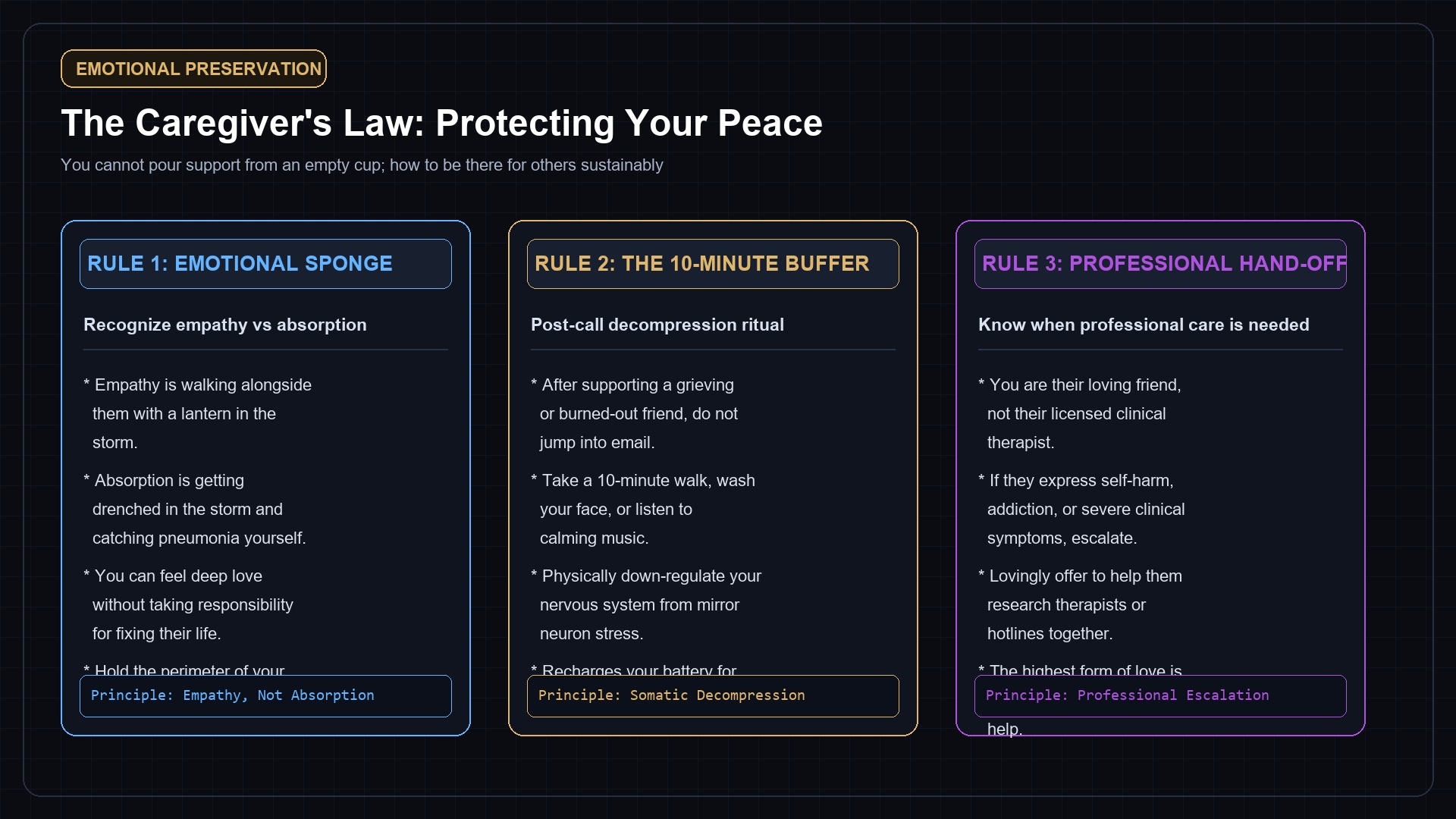
2. The Caregiver's Law: Don't Drown Trying to Save a Swimmer
Supporting someone through chronic mental health struggles is a marathon, not a sprint. If you take on their sadness as your own personal identity, you will eventually burn out, become resentful, and withdraw entirely—which harms the friendship even more.
- Differentiate Empathy from Absorption: Empathy means standing on the dock offering a steady hand; absorption means jumping into the whirlpool and drowning alongside them.
- Maintain Your Non-Negotiable Rest: Never cancel your own doctor appointments, workout routines, or sleep schedules to absorb late-night drama.
- Know Your Limits: You are their loving friend, not their licensed clinical psychiatrist or crisis intervention specialist. Lovingly help connect them to professional resources when symptoms are severe.
"Jab koi apna andhere mein doob raha ho, toh use lecture mat do. Bas chupchap uske paas baith jao. Yahan seekho..."
— Bhaway Bhalla • System Principle
"You don't need to fix their storm. You just need to hold the umbrella while they walk through the rain."
3. Creating a Low-Stimulation Sanctuary: The Power of Presence
When a friend is going through severe burnout or grief, their nervous system is in chronic fight-or-flight overload. Going to a crowded restaurant or a loud movie theater will only intensify their sensory exhaustion. Instead, offer a low-stimulation sanctuary:
- Cook a Warm Meal in Silence: Step into their kitchen, prepare soup or dal, wash the accumulated dishes, and leave a warm bowl on their counter without demanding an hour-long chat.
- Bring Them into Nature: A slow 20-minute walk under tall trees in a quiet park reduces biological cortisol without requiring social performance.
- Share Calming Soundscapes: Send them a link to restorative, lyric-free focus audio like Bhaway Beats to help soothe their racing thoughts before bed.
Read the story of enduring painful medical setbacks and discovering stoic mental peace on The Human Story.
Explore My Story on Homepage4. Preventing Caregiver Burnout: You Cannot Pour from an Empty Cup
Supporting a depressed friend is a marathon, not a sprint. If you absorb their emotional pain without establishing your own grounding practices, you will burn out and become resentful.
Set clear personal boundaries, maintain your own exercise and sleep schedules, and consult our Peaceful Living & Emotional Balance Guide. Remember that professional therapists exist for clinical treatment; your role is to be a steady anchor of unconditional love. For grounding resources, check BB Digital Twin Console and discover enterprise advisory at Work With Me.
Where Should You Focus Your Energy First?
Click any quadrant to reveal high-leverage execution priorities:
Automate your basic routines today (auto-SIP, room rent sub-limit audit, muting toxic notifications).
Skill-stacking AI automation, restructuring portfolio, setting deep-work boundaries with family/partner.
Checking monthly statements, standard car checkup, weekly housekeeping habits.
Overthinking past decisions, arguing on social media comments, timing daily stock market fluctuations.

Bhaway is a systems builder, AI architect, and digital media founder. Having managed enterprise technical operations across Concentrix (Dell & Uber) and launched platforms like AI Is Everywhere and PromptLagao, he documents first-principles frameworks across human relationships, compounding wealth, and AI leverage.
Stay Connected Inside Bhaway's Digital Headquarters
Every system, brand, and framework discussed in this article is actively maintained and operated in public. Continue your exploration:
Ask BB • Article Explainer & Summary
Interactive AI breakdown for "When Someone You Love is Drowning in Darkness..."
Jab koi apna andhere mein doob raha ho, toh use lecture mat do. Bas chupchap uske paas baith jao. Yahan seekho sahi tareeqa.
- •Toxic positivity ('just smile, it could be worse') invalidates real pain; compassionate companionship validates their heavy reality without demanding immediate emotional cheerfulness.
- •Practical micro-support removes decision fatigue: bringing dinner, running an errand, or doing silent chores beats asking 'let me know if you need anything.'
- •The Caregiver's Law protects your own boundaries: practicing empathy without absorption prevents secondary traumatic stress and emotional exhaustion.
What Should I Read Next?
You just finished exploring "When Someone You Love is Drowning in Darkness: How to Hold Space, Listen with Love, and Never Burn Out". To maximize your retention and avoid fragmented reading, follow this structured 3-step sequence:
Get 1 Practical Idea Daily.
No spam, no promotional fluff. A 2-minute actionable blueprint on modern relationships, quiet wealth compounding, or AI execution delivered directly to your inbox every morning.
FAQ
Frequently Asked Questions
What should I do if a friend stops replying to my messages completely?
Send a low-pressure anchor note: 'Hey, no need to reply to this! Just wanted to send love and remind you that you are deeply valued. Take all the time you need, I will check in next week.' This relieves their guilt.
How can I tell if my friend's burnout has crossed into clinical depression?
Burnout usually improves after a few days of restorative sleep and stepping away from work. Clinical depression is persistent (lasting more than 2 weeks) and characterized by complete anhedonia (inability to feel joy in anything), severe sleep disruption, and profound feelings of worthlessness.
Is it okay to sit in silence with a depressed friend?
Yes! Silent companionship is one of the highest forms of intimacy. Watching a movie, working quietly in the same room, or simply sitting on a couch without talking provides immense emotional grounding.
What should I do if a friend expresses thoughts of suicide or self-harm?
Take it with absolute seriousness. Stay with them or ensure someone is present, remove potential dangers, and immediately contact a crisis lifeline (such as 988 in the US/Canada or local emergency services). Never promise to keep self-harm thoughts a secret.
How do I offer to help pay for therapy without embarrassing them?
Frame it as an investment from someone who loves them: 'I want nothing more than to see you thrive. I would be honored to gift you your first 4 sessions with a specialist—no strings attached, just love.'
Why does giving advice to a depressed person often backfire?
Depression impairs executive cognitive function. Giving long lists of 'solutions' (diets, exercise, productivity hacks) feels like an impossible mountain of homework and reinforces their feeling of brokenness.
How can I protect my own mental health while being a caregiver?
Establish clear decompression rituals: take a 15-minute nature walk after heavy emotional conversations, talk to your own support network, and honor your sleep schedule unconditionally.
What practical gifts actually help someone in a depressive episode?
Pre-made meal delivery gift cards, grocery essentials delivered to their doorstep, soft weighted blankets, noise-canceling headphones, and household cleaning services.
How should I react if they lash out or get irritable with me?
Recognize that irritability is a common symptom of clinical depression and emotional overload. Remain calm, don't escalate, and gently say: 'I can see you are in a lot of pain right now. Let's take a pause, and I'll check on you tomorrow.'
Where can I read more about Bhaway's personal health overcoming story?
You can read the complete narrative of prolonged medical challenges and stoic recovery on My Story.
Topic Tags
Recommended Interactive Tools For You
Put the concepts in this article into immediate practice. Zero paywalls, instant calculations, and confidential browser-local analysis.
Relationship Health Score
Evaluate your relationship across 4 core pillars: emotional safety, trust, respect, and mutual daily effort.
Nervous System Burnout Diagnostic
Check your nervous system overload stage, emotional exhaustion, and restorative boundary requirements.
Love vs Attachment Test
Uncover whether your bond is driven by true emotional connection or subconscious fear of being alone.
Situationship Detector
Diagnose whether you're in a genuine relationship or an emotionally draining situationship with honest next steps.



Community Discussion
Comments (1)
Super insightful post! The clear breakdown made it effortless to understand and apply.
Thanks Aman! Really glad this clicked for you. Let me know what you think once you try it out!